

In this article, you’ll read why limerence so often shows up around unrequited love, forbidden love and unattainable people, and why that’s usually not “bad luck”, but a pattern in your nervous system. It’s often not that you just happen to fall in love with someone who is already taken, far away or emotionally unavailable. Most people sense that this person is out of reach fairly quickly, and that very sense of unavailability is what can trigger their system into a form of obsessive, lovesick infatuation. You’ll see how old pain, familiarity and a mix of hope and uncertainty can quietly pull you into a limerence state: intense longing, lots of fantasy, intrusive thoughts, and the feeling that you can’t really think straight about anything else.
In What is Limerence I'm already explaining that limerence is more than just “really being in love”: it's an obsessive form of love or infatuation, which often grows stronger the less available someone is.
In mijn gratis Engelstalige gids “Decode your Limerence” I also provide insight into the needs that often lie behind limerence, so you can gain more control over what's going on in your head. You can go ahead and download.
My experience: multiple limerence episodes, without knowing it had a name
Looking back on my own life, I see that I've experienced periods of limerence not once, but at least six or seven times. Again and again, I became deeply “infatuated” with someone who was fundamentally unavailable: taken, emotionally closed off, too far away, or in a role where genuine reciprocity wasn't really possible.
For a long time, I didn't know a word for it existed. I just called it infatuation, or I found myself lovesick and felt ashamed that I got so caught up in that one person, while the reality of my life just went on in the meantime.
It wasn't until I started reading about limerence that so many things suddenly clicked. Not just about my behavior, but also about the combination of old pain, attachment patterns, and the fact that unattainable love, in particular, activated my system so much. You can read more here about the difference between Just in love or limerence.
Soms schaam je je omdat je verliefdheid zich steeds richt op mensen die eigenlijk niet zo’n plek in je leven zouden moeten hebben. Limerence en schaamte geeft taal aan die spanning en wat je daarmee kunt doen.
The shame lessened when I began to understand why this was happening, and even more so when, halfway through a training program to become a trauma-informed coach, I noticed how many patterns were actually at play in this form of obsessive love.
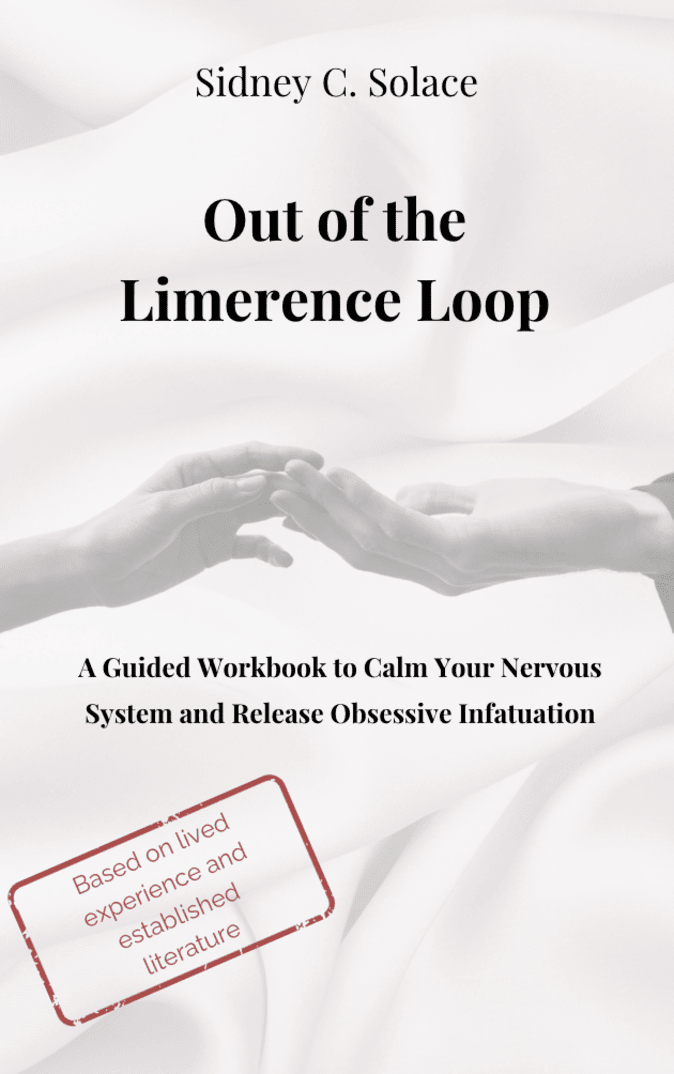
That experience is also why I wrote my theory and workbook “Out of the Limerence Loop”. Not to “fix” anyone, but to offer language and exercises to people who recognise themselves in this pattern: falling again and again for unattainable or unrequited love, repeatedly ending up in a lovesick‑like state of limerence, and not understanding why it feels so huge. In the workbook, you can gently explore which old pain is involved, which triggers your nervous system picks up, and how you can, step by step, create more space for real, mutual connection.
What is limerence, and how does it differ from unrequited love?
Limerence is often described as obsessive love or obsessive infatuation: a state in which your thoughts, feelings, and expectations are almost entirely focused on one person. You fantasize a lot, are preoccupied with signals, constantly wonder what he or she “really means,” and feel unsettled if there's no response.
Unrequited love simply means that your feelings are not reciprocated. This can be very painful but often fades slowly as clarity emerges and you grieve. With limerence, it works differently. It's precisely the combination of unrequited love, uncertainty, and small hints that keeps the system increasingly activated: it grows, becomes more obsessive, and feels almost addictive.
It's also good to know that unrequited love exists *without* limerence. You can fall in love with someone who doesn't reciprocate your feelings, grieve over it, and then slowly move on. With limerence, it often works differently: the very fact that someone is unattainable or doesn't return your love seems to only make the feelings stronger. The mix of “no” and “maybe yes” fuels the obsessive aspect. Someone who doesn't have a limerence pattern will usually give up sooner if love is clearly not reciprocal; the disappointment hurts, but enough inner resilience remains to bring their attention back to other relationships and their own life.
If you find yourself stuck in obsessive, unrequited love and don't know how to get out, also read How to stop limerence for more on recovery and relapse.
Why unreachable and unrequited love fuels limerence
Limerence thrives on a mix of hope and uncertainty. You have enough stimuli to think “maybe there's something to this,” but never enough clarity to find peace.
These situations can occur, for example:
- Someone is already in a relationship but is giving subtle signals.
- someone is your colleague, therapist, teacher, or supervisor, in which genuine reciprocity is complicated
- Someone is emotionally unavailable, but sometimes affectionate or charming
- Someone lives far away or you know them primarily online
In all these situations, you feel somewhere deep down that it can't really happen, while your head is making up stories about how it might. That's the perfect breeding ground for a lovesick-like limerence: you become increasingly attached to the idea of this person, and to the hope that it will one day be reciprocated.
In the blog Why him or her? I will delve deeper into the question of why it is precisely these individuals who stir up so much within us. And in Limerence: what is ityou often don't realize it Can you read how seemingly subtle things have a huge impact on your life.
The psychological layers beneath obsessive love
Obsessive, unrequited love is rarely just “a crush.” Attachment often plays a role: the way you learned to connect, seek safety, and cope with distance in your youth.
For example:
- Anxious attachment can lead you to be attracted to someone who isn't fully available, because you recognize that feeling of “waiting for love.”.
- Avoidant attachment can make unattainable love feel safer than someone who gets genuinely close; this way, everything stays in your head, without you having to truly open up.
- In more chaotic attachment patterns, the back-and-forth between hope and rejection can feel familiar, however painful.
In Limerence and attachment styles I'll explain that in more detail. If limerence keeps recurring, with different people each time, it's often the underlying layer of attachment and old pain that needs attention. You can read more about this in If limerence seems chronic.
What you often don't realize while you're in the midst of unrequited limerence
While you're in the middle of it, it often doesn't feel like a pattern at all. It feels like a unique, deep, special love. That's why it can also be difficult to see that it's actually an obsessive dynamic.
Typical thoughts include:
- “If he/she finally truly sees who I am, everything will be okay.”
- “This is just very faithful, pure love, there's nothing wrong with that, is there?”
The tricky part is that limerence can indeed feel very intense and faithful, but in practice, it often takes a lot away from your life: time, attention, energy, self-esteem. It makes your world very narrow, with the other person at the center, while your own body, needs, and boundaries often fade into the background.
In Limerence is similar to addiction I'm describing how this feels when you're constantly seeking a “rush”: a message, a glance, a mini-contact.
And Limerence and your smartphone Do you see how constantly checking, scrolling, and waiting for a signal can further feed that lovesick state.
What's going on in your head?
Underneath that experience is also a neurochemical layer. Your brain reacts to small signals of attention or rejection with a mix of dopamine, oxytocin, serotonin, and stress hormones, among others. Dopamine is the substance related to motivation and reward: every app notification, glance, or mini-interaction with this person can feel like a “win,” causing your system to chase the next stimulus even more. Because that reward is unpredictable – sometimes there's a message, sometimes silence – a kind of gambling addiction effect arises: your brain reacts extra strongly to the uncertainty itself, just like with a slot machine where you never know exactly when you'll win. At the same time, your serotonin often decreases, which is linked to more intrusive thoughts and an obsessive focus, and attachment systems are activated via oxytocin, among other things. All of that together makes limerence not only feel emotionally intense but also physically resemble addiction: you get used to the highs of “maybe” or “a nice moment of contact,” and the lows of “hearing nothing” can feel like real withdrawal.
If you find that this love is hurting your life, Limerence and Boundaries: When It Hurts Your Life a blog that can help you find some words and first steps for that.
First small steps when you're stuck in obsessive, unrequited love
You don't have to break everything down at once. Especially with limerence, it usually works better to take small, achievable steps, with a lot of kindness towards yourself.
A few first steps could be:
- Identify that it concerns limerence.
Just acknowledging that this is more than “bad luck in love” helps you emerge from the confusion. It gives you a name for it: this is obsessive, lovesick-like love, and that's something that happens more often. - See that the other is unattainable or unanswered.
Not just in your head, but on paper: what facts show that reciprocal, healthy love isn't really possible here? It hurts to see that, but it makes you less dependent on hope alone. - Limit the decoding of mini-signals.
Try to build in moments where you consciously say: “I'm not going to overthink this today.” Check less, interpret neutral gestures less, and ask “what did he/she mean by this emoji?” less. - Bring your attention back to your own life and body.
Small exercises such as noticing what you see, hear, and feel, or consciously planning things that have nothing to do with this person, can help to loosen the circle in your head a little. - Make room for grief and loneliness.
Obsessive love often conceals a deeper layer of grief, an old loneliness, or the feeling of never truly having been chosen. You don't have to solve that all at once, but it's okay to acknowledge it.
For real structured processing, for example practicing boundaries, figuring out where this pattern comes from, and new ways of dealing with desire, I have my workbook gmade: as a quiet, practical place where you don't just read this, but also really work through it at your own pace.
To think about yourself
Perhaps it helps to gently ask yourself one or two of these questions:
- What makes this person so “unattainable” to me, and what draws me to that?
- Honestly, what earlier situation does this remind you of (e.g., in family, previous relationships, friendships)?
- What is this obsessive love doing to the rest of my life – my work, my body, my other relationships?
- What would real, reciprocal love do differently than this situation?
You don't need to have perfect answers here. Just seeing that these questions exist is an important step in itself.
It's not weird or bad that you keep falling for people who are unattainable. Limerence and lovesick-like infatuation are intense, but also understandable. And when you start to see that it's not just about this one person, but about a deeper pattern, you can learn step by step to approach love, boundaries, and yourself differently. Small steps are enough.
Frequently Asked Questions about Limerence and Unrequited Love
Is unrequited love always limerence?
No. Unrequited love can also occur without obsession. Limerence is mainly about the combination of unrequited love, a lot of fantasy, intrusive thoughts, and a feeling of addiction to the other person. It is, however, logical that someone who does not suffer from limerence in an unrequited love situation would lose interest in that person more quickly.
Why do I always fall for people who are unattainable?
This often has to do with attachment and old pain. Unattainable love can feel familiar if you're used to waiting for love, or never being chosen completely.
Can obsessive love ever become healthy?
The intensity can subside as you begin to see the pattern and work with it, but the core is that real, healthy love is reciprocal and safe. Not everything that starts obsessively will automatically become healthy. But within the right circumstances and with the right person, it's not out of the question.
Should I always go no contact with unrequited limerence?
Not everyone has to go no contact in the same way, but if the contact keeps feeding the obsession, distance might help. No contact with limerence Read more about it.
Am I a bad person for being in love with someone who is taken?
No. Feelings often arise outside of your conscious control. What matters most is how you deal with those feelings: what boundaries you maintain, how you take care of yourself and others, and whether you seek help when you realize you're stuck.
About the author

Sidney C. Solace is a writer with a background in investigative journalism and years of personal experience with limerence and, more importantly, overcoming it.
She explores the psychological patterns behind obsessive infatuation and attachment, and writes for people who seem to function on the outside but feel completely consumed by one person on the inside. In Out of the Limerence Loop, she combines theory and practice to give readers more language, calm, and direction on their path to recovery.