

In this article, you'll read what “no contact” means in limerence, why taking distance can feel extremely painful and unnatural, and why less contact is often necessary to break the limerence cycle and calm your nervous system – even if complete no contact isn't practical..
Many people who are stuck in limerence feel at some point: This can't go on any longer.. The obsession drains energy, your life shrinks around one person, and every text message, every glance, or every silence can completely throw you off balance again. Then the advice quickly comes: “you just have to go no contact.” But anyone in the middle of it knows that this often feels much more complicated than it sounds.
From experience, I also know how strong the tendency can be to convince yourself for a while longer that it's “manageable,” that you'll “deal with it,” or that you just need to have a bit less contact. It's often easier to stay in that in-between space a little longer than to truly face how much this dynamic has a grip on you.
For many people, no contact is ultimately a form of self-protection: in Limerence and boundaries: when it hurts your life llet me show you how limerence can concretely permeate your work, relationships, and daily life, and why setting boundaries can be not only brave but also necessary. No contact is one way to draw boundaries, but sometimes professional help is needed. In Limerence Treatment: What Help Is Right for You? You'll find more about therapy, coaching, and self-help.
What means "no contact" exactly
In limerence, no contact usually means more than just not sending messages. It's about stopping or reducing all stimuli that feed the obsession as much as possible, such as direct contact, checking social media, rereading old conversations, or seeking information through others.
This is important because contact often reactivates limerence again and again. Small signals can be enough to sharpen hope, excitement, and obsessive thoughts. For many people, it's not so much actual contact but especially the phone that makes no contact difficult: constantly checking if someone is online, interpreting blue ticks as codes, and then opening a conversation again. Limerence and your smartphone I will describe how these digital patterns work and how you can practice them carefully.
Why does taking distance feel so painful?
From an outsider's perspective, stepping back can sometimes seem like a logical decision. For someone in the throes of limerence, it often feels like loss, unease, and panic. This is partly because the other person has become not just an individual, but also a vessel for hope, desire, and emotional significance.
Do you notice that no contact feels so difficult because your system keeps hoping for just one more sign? Then you can The limerence loop help to understand why that urge keeps coming back so strongly, even when you actually want to stop.
It's not strange that no contact feels so intense. You're not just distancing yourself from someone, but also from the fantasy, the hope, and the “maybe someday” that has come to life in your head. If you notice that this isn't your first limerence experience, but another in a string of similar situations, then When limerence seems chronic: from one obsessive crush to the next a valuable deepening to better understand what is happening at the pattern level.
What keeps the contact going
As long as the limerent dynamic is still active, contact often works as fuel. A text, a meeting, or even just checking someone's online presence can restart the cycle.
The cycle often looks something like this: temporary relief or euphoria, followed by new uncertainty, then analyzing, hoping, checking, and waiting again. That is precisely why many sources call drastically reducing contact one of the most important first steps in recovery.
If you find your mind won't stop racing, even after you've implemented no contact, this blog post may be helpful: Limerence and closure: when your mind won’t let go after the contact ends.
It is normal that you keep bouncing back and forth between relief and a strong urge to reach out again. In Limerence: Two Realities I will explain why those two feelings exist side by side.
If complete no contact is not feasible
This is where the real pain lies for many people. Completely distancing yourself sounds easier than it actually is. Sometimes it's about a colleague, someone from your friend group, an ex with practical entanglements, or someone you keep running into repeatedly in a small social circle.
In such situations, no contact at all isn't always realistic. This doesn't mean no progress is possible, but rather that “distance” sometimes takes on a different form: less contact, more functional contact, less exposure, and fewer additional channels that feed the obsession.
That's precisely why I wanted to address it in my book. Not everyone can simply disappear from a situation. And especially when that's not possible, you often need extra clarity about what you can still limit, reduce, or do differently.
If you want to not only distance yourself but also better understand how to stop limerence step by step, you can How to stop limerence to be a helpful next step.
The tendency to lie to oneself
A difficult truth about limerence is that you often don't immediately choose what brings you the most peace. Many people first choose what causes the least acute pain: a little more contact, keeping one more channel open, just “looking for a moment.”.
That's human nature. From experience, I know how tempting it is to tell yourself that it's not that bad, or that you can really handle it as long as you pay a little attention. But precisely those half-openings can be enough to keep the whole dynamic alive.
In my book, I don't mention that denial to be harsh about it, but because it is often a crucial turning point: the moment you start to realize that your system isn't reacting neutrally to this person, and that “a little contact” sometimes does a lot more than you want to admit to yourself.
No contact is not a punishment
With regular dating content, no contact is sometimes portrayed as a strategy to get someone back. With limerence, that's not the case. Here, taking distance is not a game or a power play, but a form of self-protection.
The goal is not to make the other person feel something. The goal is to put your own nervous system on alert less often, so that space is created for reality, peace, and recovery.
Do you notice that, despite no contact, you keep dwelling on the question of why it had to be this particular person? In this article, I will delve deeper into why specifically he or she is such a strong trigger for your limerence. If, besides no contact, you also want to understand why smaller boundaries can already feel so unnatural, you'll find in Limerence and boundaries: why recovery goes against your tendencies More explanation and examples.
If you have already broken contact
If you notice that during a no-contact period your mind fills with intrusive thoughts about this person, my blog can help. Intrusive thoughts in limerence to understand what's happening there and how to deal with those thoughts with more gentleness and structure.
Less black and white than it seems
No contact is often discussed in very black-and-white terms: either you do it or you don’t. In reality, many people fall somewhere in between, especially when there are practical limitations. In those cases, it helps not only to think in terms of “cut off all contact or fail,” but also to honestly assess which forms of contact most strongly fuel your limerence.
That doesn't mean distance suddenly becomes easy. It does mean you can more precisely see where your vulnerability lies: in app contact, in unexpected encounters, in checking online, in fantasizing after minimal interaction, or in holding onto hope.
Why this is also about self-knowledge
No contact is never just a practical decision with limerence. It also confronts you with deeper questions: what am I actually looking for in this person, what do I hope this will resolve, and why does letting go feel almost worse than continuing to suffer?
This is precisely where limerence often intersects with old patterns of attachment, validation, and emotional hunger. This doesn't make recovery simple, but it does make it humanly understandable. Google emphasizes the importance of experience and genuine expertise in people-first content, and on this topic, that firsthand experience is often precisely what provides recognition and trust.
Still in doubt whether this is “just” infatuation or truly limerence? In this article, I explain What's the difference between regular infatuation and limerence.
In Limerence and anxious attachment Let me show you how an anxious attachment style makes no contact feel extra difficult, and what small regulation steps are still possible.
If you are in the middle of this
If you're reading this while you already know somewhere that this contact drains you more than it nourishes you, then that's a painful but important insight. It's very human to tell yourself for a while longer that it will be okay before you actually take the step to change something.
I'm not just writing about this from a theoretical standpoint, but also from the experience of how convincing limerence can feel while at the same time pulling you further and further away from yourself. That's why my book contains not only explanations but also an exercise focused precisely on this point: learning to see more honestly what contact gives you in the short term, and what it costs you in the long term.
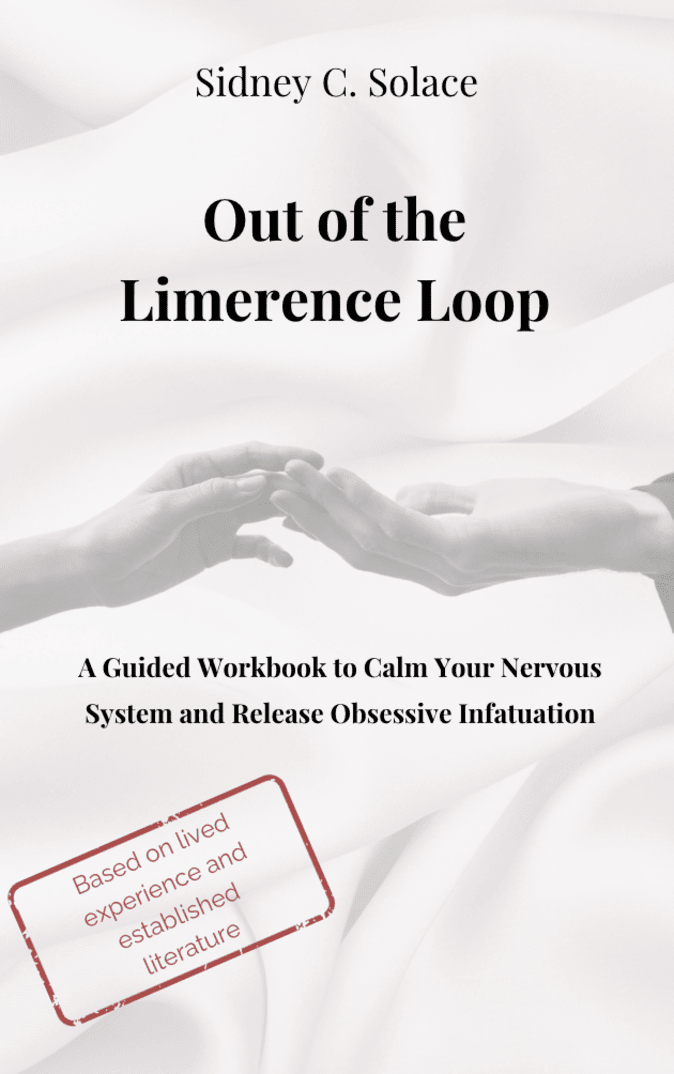
In Out of the Limerence Loop I also consciously pay attention to situations where complete contact is not feasible, such as with a colleague or someone from your friend group. Nuance is often needed there even more, plus exercises that help to react not only out of hope or impulse, but out of more clarity and self-protection.
What is limerence exactly?
Would you like to calmly re-read what limerence is? In this article, I will explain step by step what limerence (obsessive infatuation) is and how to recognizes.
Frequently Asked Questions About No Contact with Limerence
Is no-contact always necessary to get over limerence?
No contact isn't a magic button. Even if you don't see or speak to someone, you can constantly think about them. However, it is one of the powerful ways to partially break the cycle, because any contact can reignite limerence. Less contact or more conscious contact can help, but as long as triggers keep coming in, the loop often remains active.
How long does it take for it to get better if I have (almost) no contact?
That varies from person to person, but many sources describe that the worst peak is often in the first weeks to months and that the intensity gradually decreases afterwards if you truly and consistently allow fewer stimuli. With continuous contact or frequent checking from a distance, limerence can actually last for years.
What if no contact is impossible because it's a colleague or someone from my friend group?
No contact at all isn't always realistic for Dan, but you can opt for contact that is as functional and limited as possible: work or group-related, no extra texts, no private contact channels, no online following. In my book, I dedicate separate attention to this and provide exercises to create more distance step by step within such a difficult situation.
Why does no contact sometimes feel worse than “just moving on”?
Because then you're not just letting go of a person, but also the hope, the fantasy, and the dopamine hits that come with every contact; you end up in a kind of withdrawal phase, which often feels heavier at first than remaining stuck in a familiar but painful pattern. Without preparation and support, there's a high chance you'll relapse into contact during that phase.
Am I weak if I can't go no contact right away?
No. Limerence taps into attachment, neurochemistry, and old patterns, so creating distance often requires more than “just pushing through.” In my book, I work with small, honest steps and exercises that acknowledge that your system doesn't switch overnight: Out of the Limerence Loop.
About the author

I am Sidney, writer, researcher, and the driving force behind Sid's Saferoom. In addition to my years of personal experience with breaking free from limerence, I am certified Trauma-Informed Coach (IPHM-accredited via Kirsty Watson, The Complete Approach).
Knowing firsthand how lonely and exhausting obsessive infatuation can be, I dedicate my work to helping others heal. I write about it and developed the theory and workbook Out of the Limerence Loop. My mission is to provide you with the psychological insights and practical tools needed to interrupt the obsessive loop and restore peace to your nervous system.
- Want to know more? Read my full story on the About me-page.
- Weekly support? Subscribe to my English-language essays at substack.com.