

In this article, you'll read why you often continue to have inner conversations with someone for a long time after limerence, even if you were the one who consciously said “no” to the relationship or contact.
This is important to understand when you rationally know that your breakup is valid, but meanwhile notice that your mind seems to ask every day, “Hey, can we talk?”, as if there is still some sort of relationship in your inner world.
You'll be reading about what psychologically happens when limerence turns someone in your system into an inner dialogue partner, what roles those imaginary dialogues fulfill, and what initial gentle steps help you to find yourself in that conversation less often without forcing yourself.
10 Valuable Insights in a Free Guide
Some people who land on this page have googled limerence tens of times. You know the definition. You know the stages. But there's a big difference between knowing what it is and actually getting out of it. I wrote a free guide with 10 insights that go a bit deeper. A guide that can help you on your way and explain that you are not alone.
My experience: saying no and still talking
I've personally experienced consciously distancing myself from someone multiple times. Sometimes I was the one ending the relationship, sometimes the one clearly telling myself, “This contact is causing me more pain than good.” On paper, it was clear. In the outside world, it was over.
But in my head, it wasn't just over. I noticed I kept having conversations with that person for a long time, as if they had remained as some kind of inner dialogue partner. I heard what I “really” wanted to say, what they might have answered, how a conversation could have gone if I had been stronger, gentler, more honest, or clearer. In those dialogues, it seemed as if I was given chances again and again to finish the story better.
This made the process confusing: on one hand, I stood behind my breakup, and on the other, it felt like some kind of relationship was still going on internally. It's precisely that experience – that limerence doesn't stop when contact ends but can continue in the form of internal conversations – that is one of the reasons why I started writing about this subject matter, and why I created my workbook. Not only for the practical process of letting go, but also for that part of you that just keeps talking, hoping, and correcting internally.
It can be confronting to discover how much time you spend in internal conversations, fantasies, and potential future scenarios. In Recognizing limerence: why the first stage of recovery is so difficult read why noticing that is a vulnerable, yet important first step.
I myself said “no,” but my head says every day, “Hey, can we talk?”
Many people expect that breaking off contact also means the end of inner tension. In practice, that is often not the case. For someone with limerence, a breakup feels not only like stopping texts or meetings but also like the loss of a source of hope, meaning, and validation.
Your brain has by now built a kind of inner stage on which you and your significant other remain standing. After contact ceases, that stage usually remains for a while. You notice this in things like:
- imaginary conversations in your head, in which you go over everything again
- dialogues where you say things that LO never actually said
- Scenarios where you try to explain, save, nuance, or restore
- inner dialogues about what you should have done or said
It often feels like you're “overthinking,” but it's actually more than that: it's ongoing conversations with an internally created version of that person. Limerence often makes your LO not just a person, but also a kind of inner role: someone to whom you explain everything, someone from whom you hope for a different answer, someone with whom you check your own story.
In What is Limerence I'm already writing that limerence is largely about intrusive thoughts, fantasy, and hope. This blog zooms in on one specific form of that: inner dialogues, where your brain keeps inviting your ex or LO as a sort of inner talk show guest, even if he or she is no longer in your life.
Limerence transforms your ex into an inner dialogue partner
Psychologically speaking, your brain is doing something very human: it's trying to piece together a story that doesn't feel neatly resolved in the outside world. There are often things left unsaid, questions without answers, and emotions that haven't found a place yet.
Limerence amplifies that process. Because the intensity was so high – a lot of hope, anticipation, idealization, fear of loss – the end rarely feels like a peaceful, small moment. It feels more like an abruptly canceled series. Your system wants to know: what exactly was this? Who was I in this? Could it have turned out differently?
Instead of keeping it to yourself, your brain uses the other person as a kind of internal conversation partner. In your head:
- Does he tell you what he could have meant
- Does she still give the confirmation or apology you were waiting for
- Do you repeat conversations, but with different outcomes
- Ask your questions, to which you simulate an answer internally
These are not neutral thoughts, but ongoing dialogues with an internally created version of him or her. Limerence makes that internal version feel very alive, almost as if there's still a kind of relationship going on, but in your head.
In Limerence and unrequited love I'm already describing how unrequited and unattainable loves make the system extra sensitive to fantasy and inner scripts. After a breakup, you often see the same dynamics returning, but less in text messages and more in internal conversations.
Three roles that fulfill inner conversations
Inner monologues sometimes seem to happen “out of the blue,” but they often serve specific functions. Gently naming them can be helpful, so you don't just think “I'm ruminating,” but also see what your system is trying to do.
Make grief manageable
A breakup calls for grief: saying goodbye to someone, to a future vision, to a version of yourself in that relationship. That is heavy. Inner conversations try to make that grief a bit more manageable.
By replaying conversations in your head, you can continue to feel that there is still interaction: you are not completely cut off, there is still contact, even if it is imaginary. This can be temporarily soothing, as it makes the farewell process feel less abrupt.
2. Regaining control over a past story
Limerence is often amplified by unpredictability and uncertainty. In an internal dialogue, you have more control: you choose what is said, how he or she reacts, how it ends.
Your brain sometimes uses your loved one as a kind of imaginary co-therapist or critic: someone to whom you re-explain the story repeatedly until it feels “right.” You try to correct mistakes, clear up misunderstandings, and still present yourself as you would have wanted.
In fact, that gives a feeling of control over something that was actually very elusive. Your inner world can rewrite the story, so you're not left with a raw, unfinished version.
3. Simulating connection without actual proximity
Finally, inner conversations often serve as a simulation of connection. You miss that person, you miss the form of togetherness, you miss the excitement, the recognition, and perhaps also the safety you thought you felt.
By talking to him or her in your head, you simulate a form of contact. You feel less alone for a moment because someone still seems to be present internally. For a nervous system that has long leaned on this one person as a source of intensity and meaning, that can be very attractive.
The problem is just that these inner conversations often get you stuck too: your system doesn't get a real new experience (namely: connection with others, with yourself, with something else in your life), but keeps circling around the same interaction.
Blogs as Limerence: what you don’t see when you’re in it en Intrusive thoughts in limerence Go deeper into this. They give language to what happens when your mind won't quiet down, even after breaking.
Limerence as an inner talk show: why your brain keeps inviting him as a guest
You can also see limerence as a kind of internal talk show. You are the host, and your brain keeps inviting the same guest over and over: your LO.
On the talk show:
- Ask questions that have never really been answered.
- Do you still get the recognition or love you were looking for?.
- Are you going back to scenes from the past together to “re-edit” them.
- Practice how the conversation could have gone, with a better outcome.
That's not madness; it's a form of mental simulation that occurs in many people. It's only in limerence that it gets much more weight and emotional charge than in an average crush or relationship. It doesn't feel like a light-hearted fantasy, but like a necessary repetition, as if your brain is trying to fix something that cannot be fixed.
By viewing it this way, as an inner talk show, you can also notice when you are “recording an episode” again. That moment of noticing is important because it creates space between you and the conversation. You are not just the one who gets sucked into it, but also the one who can see it happening.
In Life After Limerence It's more about what a life could look like when that talk show is no longer the daily main programming.
How to speak less often in conversations, without forcing yourself
You don't need to worry about never having an inner monologue again. Recovery usually doesn't start with “never again,” but with “a little less often and a little more consciously.” A few small steps can help with that:
- Call it by name
Softly say to yourself: “I am now having an inner conversation with him/her.” This creates a bit of distance: you are not it, you are doing it. - Notice the role the conversation is playing now
Question: “Am I trying to soften grief, regain control, or simulate connection?” Just making that distinction makes it less mysterious and often less compelling. - Leave one sentence unspoken
When you notice you're playing out an entire scene again, you can practice not saying one sentence in your head. That sounds small, but by not playing the script out fully, you give your brain a mini‑signal that the conversation isn't the only way to deal with that feeling. - Bring your attention back to your body and your surroundings
Name what you see, hear, smell, or feel in your body. For example: “I feel tension in my chest, I hear birds, I see light.” This helps you to come out of the talk show and back into the moment. - Give another “guest” a few minutes of airtime
You can literally say to yourself: “Now I'll have a conversation with myself / a friend / something I want to build.” Briefly think of someone who supports you, or a project that energizes you. This way, your brain notices that there are also other forms of connection and meaning.
In No contact with limerence It's about boundaries in the outside world. This blog is about boundaries in your inner world: talking less with an old internal version of your significant other, making more room for your own voice.
How my workbook can help with inner dialogues
A blog can do a lot for recognition and initial understanding, but those who engage in internal dialogues after limerence often benefit from repeated practice. Precisely because your brain is so familiar with this talk show mode, it takes time to learn a different way of dealing with longing, uncertainty, and grief.
In my workbook “Out of the Limerence Loop.” Do you find exercises that help to:
- to make your personal inner scripts visible
- better to recognize when you are in a conversation with your LO version
- taking the step from “talking with them” to “talking with yourself and others”
- to support your nervous system in tolerating absence without immediately resorting to fantasy and old dialogues.
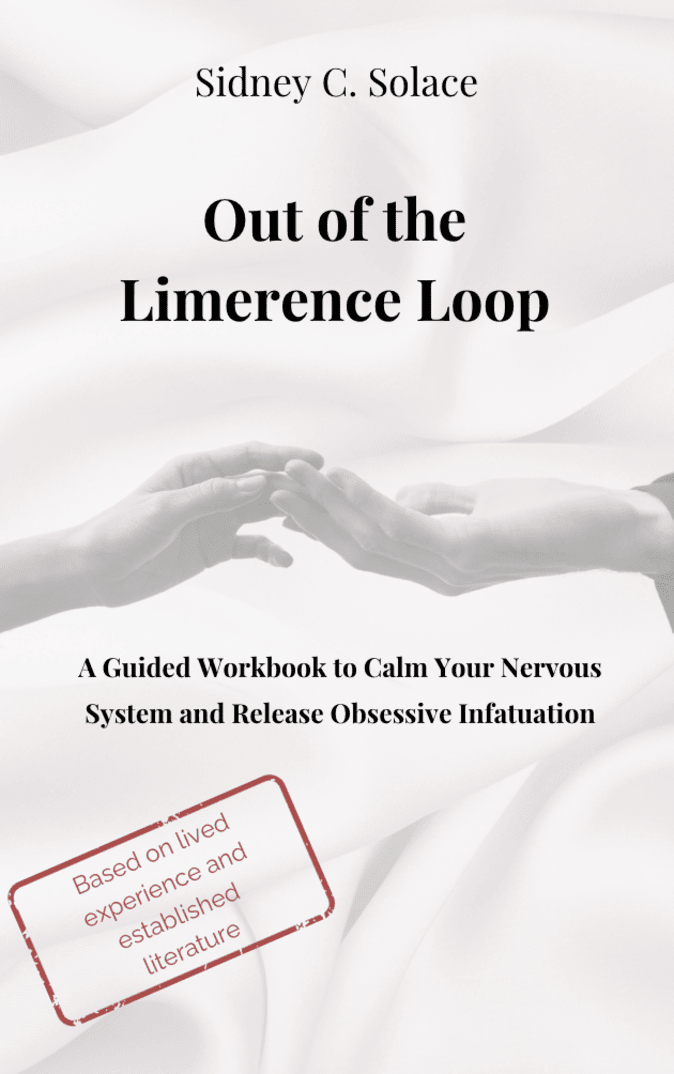
My goal is not to “fix” anyone, but to provide language and practical steps for people who notice they are internally only talking to one person, even though they rationally know that relationship is over. If you want to work through this step by step, my workbook will help you go through these processes calmly and in a structured way.
To think about yourself
Perhaps it helps to gently ask yourself one or two of these questions:
- Who am I having the most conversations with in my head right now, and what does that say about what I need?
- What do my inner conversations most often revolve around: explaining things, receiving apologies, being seen, being rescued?
- What role do these dialogues play for me: softening grief, seeking control, simulating connection?
- Who or what else would you like to invite as a conversation partner into your inner world, besides your LO?
You don't need to have perfect answers here. Seeing that there are internal conversations, and that they are trying to do something for you, is an important step in itself.
You are not “crazy” or “bad” for continuing to talk in your head to someone you have let go of in real life. Limerence is intense and often clings to your inner world. But it is something you can learn to recognize, soften, and slowly move beyond. Small steps, a lot of kindness, and gradually more space for your own voice—you can truly trust that.
Frequently Asked Questions about Limerence and Conversations in Your Head.
Is it normal to still have conversations with my ex in my head?
Yes. In limerence especially, it's very normal to have inner dialogues for a long time. That doesn't mean your breakup was wrong; it means your system needs time to process the story.
Does this mean I secretly want to reconnect?
Not always. Sometimes it mainly means your brain is trying to organize grief, control, and connection, and perhaps fantasizing about a more harmonious ending than it actually was. It's possible that real contact would hurt you more than it would help, and that you know this very well yourself, even if your head wants more conversations.
Does this fall under intrusive thoughts, or is it something else?
Inner conversations fall somewhere between intrusive thoughts and fantasy. In Intrusive thoughts in limerence Read more about the difference and how to deal with it.
Will these inner dialogues go away on their own?
They often become less frequent and less intense as you process your grief, set boundaries, and shift your focus more towards yourself and other relationships. The process is rarely linear, so don't be angry with yourself if you sometimes slip back; space will gradually open up.
Am I weird for sometimes talking to myself as if he were still here?
No. That's a human way of dealing with loss, pain, and uncertainty. The most important thing is to become aware of it and also learn to listen to your own voice in those conversations, and not just to the inner version of him or her.
About the author

I am Sidney, writer, researcher, and the driving force behind Sid's Saferoom. In addition to my years of personal experience with breaking free from limerence, I am certified Trauma-Informed Coach (IPHM-accredited via Kirsty Watson, The Complete Approach).
Knowing firsthand how lonely and exhausting obsessive infatuation can be, I dedicate my work to helping others heal. I write about it and developed the theory and workbook Out of the Limerence Loop. My mission is to provide you with the psychological insights and practical tools needed to interrupt the obsessive loop and restore peace to your nervous system.
- Want to know more? Read my full story on the About me-page.
- Weekly support? Subscribe to my English-language essays at substack.com.