

In this article, you will read how to recognize the difference between regular infatuation and limerence (obsessive infatuation): what feels different in your body, your thoughts, and your relationships, and why limerence often says more about old patterns than about a “perfect match.”.
Many people who experience limerence wonder: is this just real, deep love, or is there “something wrong” with me? It feels more intense than anything you've experienced before, you can't get out of it, and every small signal from the other person seems to carry enormous weight. Precisely because it feels so big, the intensity is often seen as proof that it must be special.
Yet both research and practical experience show that limerence is fundamentally different from regular infatuation. In this article, I will outline the most important differences. If you would prefer a calm, detailed explanation first, you can start with What limerence specifically is and how to recognize it in your daily life.
Why this distinction matters so much
As long as you primarily see limerence as “love, but worse,” letting go feels almost like a betrayal of love itself. Your thoughts quickly turn to “if I truly love someone, I shouldn't just give up, right?”.
But limerence isn't just about romance. It's also about insecurity, unattainability, old pain, and a nervous system that goes into a kind of survival mode. When you start to see that difference, it becomes easier to be kinder to yourself and consider other choices than to keep hoping endlessly.
If you notice that your feelings are not only intense but also cause your boundaries to shift and your life to start hurting, read on in Limerence and boundaries: when it hurts your life and discover what first steps you can take to get more space for yourself.
If you notice that you not only feel a lot, but are also constantly busy psychologically dissecting the other person, it helps Why you try to understand everything about that other person I understand that pattern and to shift more gently towards the question: what do I actually want?
What is common infatuation?
Ordinary infatuation can be intense: butterflies, enthusiasm, thinking about someone a lot, nervousness when you see each other. You feel attracted to the other person, want to impress them, and seek contact.
But there are a few characteristics that you often see in healthy, reciprocal infatuation:
- Your own life continues to exist
You're very focused on the other person, but work, friends, and your own interests don't completely disappear. - Your feeling aligns with reality
The relationship grows in stages, with real connection, mutual interests, and increasing clarity. - Safety is increasing
As you get to know each other better, more peace arises: you no longer need to seek validation every hour. - There is room for two people
The other person is important, but you don't completely lose yourself; you can still feel what you need and where your boundaries lie.
If you want to better understand why limerence can feel so different from ordinary infatuation, read The first important book about limerence: what Dorothy Tennov taught us. There I explain how Tennov made a distinction between intense preoccupation, insecurity, and more calm, reciprocal connection.
Infatuation can be exciting and sometimes confusing, but it doesn't feel like a state that completely takes over or that you have no control over. If you recognize yourself in the more obsessive side of the signs, it can be helpful to then How does limerence develop and how long does it last? tto read, so you can better understand why it can be so stubborn and what you can do about it.
What is Limerence in short?
Limerence is a term for a much more extreme form of fixation on one person. You become obsessively preoccupied with someone, often with very little actual information to go on.
Important elements that consistently recur in literature and personal accounts:
- You're thinking about that person almost constantly, even when you don't want to.
- Your mood swings up and down based on small signals: a text message, a like, a glance, or precisely a silence.
- You strongly idealize the other person and fill in a lot through fantasy and scenarios.
- Your own life feels like it's on standby; the other person becomes the center of your inner world.
- Uncertainty, distance, and mixed signals seem to amplify feelings rather than reduce them.
It feels less like “being in love with someone” and more like being trapped in a system that eats up your attention, time, and energy. If you notice your smartphone has almost become an extension of your infatuation, with constant checking, viewing last seen, and re-reading messages, then you'll probably recognize a lot in my blog. Limerence and your smartphone.
Sometimes it's not just the person themselves, but rather the fact that they are unanswered, forbidden, or unattainable that triggers limerence. Limerence and unrequited love read how that works in your nervous system.
If you want to understand what signals you might have missed while you were in it, close limerence: what you often don't realize while you're in itt Good to hear what you've read here.
Infatuation vs. Limerence: The Key Differences
Below is an overview of a few key differences, summarized in words.
Focus
- Infatuation
The other person is important, but not everything. You can also be busy with other things and get distracted by work, hobbies, or friends. - Limerence
The other person becomes the center of your inner world. You notice that almost everything – plans, mood, attention – starts to revolve around that person internally.
2. Relationship with reality
- Infatuation
Your feelings are strong, but there's a fairly direct link to what's actually happening between you: real conversations, shared experiences, slowly growing intimacy. - Limerence
The inner world often becomes much larger than the facts. Sometimes there is hardly any real contact, but in your head, a continuous story unfolds full of meaning, hope, and interpretations.
3. Stems and Stability
- Infatuation
Your mood is sensitive to others, but you don't completely hit rock bottom with a day of little contact. There is a basis of stability. - Limerence
Your emotional balance is heavily reliant on the other person: a small signal can give you a huge high, while a small rejection or silence can feel like an emotional crash.
4. Space for yourself
- Infatuation
You can still reasonably feel what you want and need. You sometimes compromise, but don't lose your own rhythm entirely. - Limerence
You notice your boundaries shifting, neglecting yourself, or doing things that don't feel right, as long as there's a chance for attention or validation.
5. Role of uncertainty
- Infatuation
As the relationship becomes clearer, the tension usually decreases and more peace comes. - Limerence
Uncertainty, inconsistent contact, and unreachability seem to fuel the feelings. “Maybe” becomes an engine that keeps your brain running at full speed.
Why limerence can feel so “deep” and “special”
Limerence often feels not only intense but also significant: it seems greater than previous infatuations and can give the feeling that it is “destined.” That experience is real – but the explanation is often less romantic than it feels.
In many cases, limerence touches upon:
- old patterns are seen around, abandoned, or chosen
- childhood experiences in which love was not self-evident, predictable, or safe
- a deep feeling of loss or emptiness that you unconsciously hope to resolve through this one person
Research into attachment styles shows that a significant portion of the population has an insecure attachment, and that this group is more sensitive to extreme separation anxiety, obsessive infatuation, and holding onto unattainable partners.
This does not mean that limerence can always be directly traced back to a single childhood trauma. However, it does mean that it is often a mixture of the here and now and patterns that have been in your system for a long time. If you recognize many of the signs of limerence and are also already in a relationship, you will find in in love with someone other than your partner more recognition and explanation about how complicated it can feel when that obsessive infatuation happens outside of your relationship.
Do you find yourself getting stuck particularly on the question of why it has to be this specific person? In this article, I delve deeper into why specifically he or she is such a strong trigger for your limerence.
What does this say about you – and what does it not?
Important to mention:
- Limerence does not mean you are over-the-top, dramatic, or “weak.”.
- It means that your nervous system reacts very strongly to a specific combination of attraction, uncertainty, and hope.
- It often means that old themes – such as not being chosen, not being enough, or having to earn love – are revisited in a new way.
It's painful to notice that a connection that feels so special also brings so much tension, anxiety, and loss of self. But precisely there often lies the entry point to healing: not by harshly judging yourself, but by starting to see which patterns are active here.
If you recognize yourself in this
If while reading you mainly thought, “ouch, that's me,” then that is both confronting and a first form of clarity. Seeing the difference between love and limerence doesn't mean your feelings weren't real; it means you're also allowed to look at what this dynamic costs you.
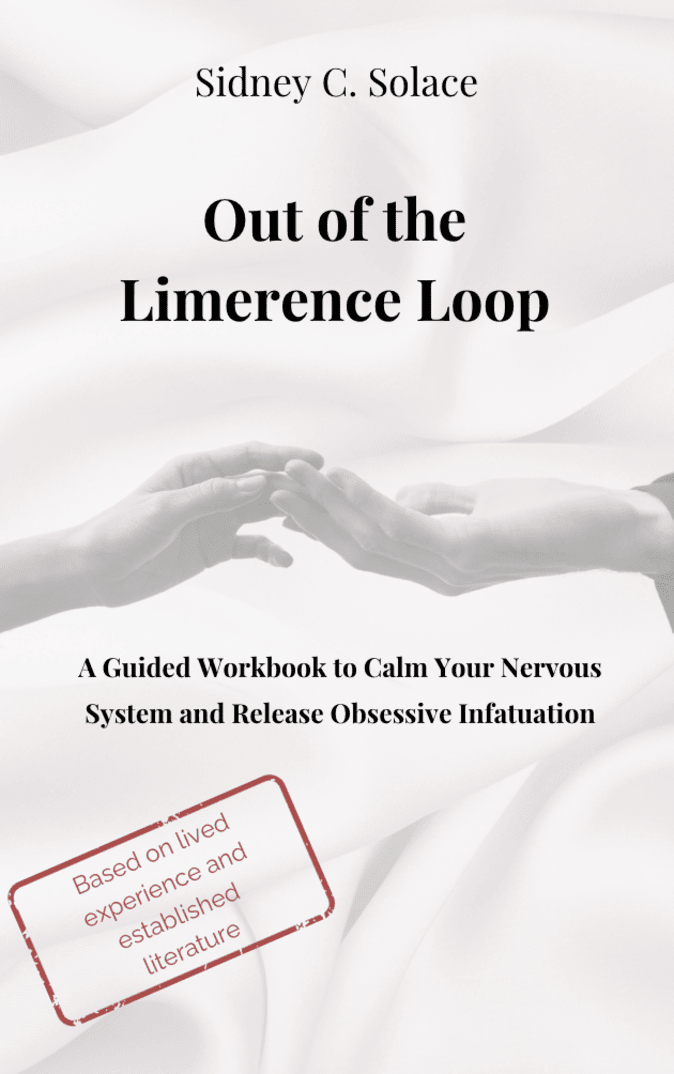
In In "Out of the Limerence loop" – the theory and Workbook for Those Stuck in Obsessive Infatuation I'll go deeper into:
- What exactly happens in your brain, body, and relationships with limerence
- how attachment, youth, and previous experiences play a role in this extreme fixation
- and how to make more space for your own life step by step, instead of letting everything revolve around one person
The book Out of the Limerence Loop is for people who seem to function fine on the outside, but quietly notice that one person is taking up far too much space inside. It doesn’t dismiss your feelings; it offers a more honest, human framework – and a starting point for gently loosening the grip of obsessive love.
Would you like to calmly re-read what limerence is? In this article, I will explain step by step What is limerence?obsessive infatuation) and how to recognize it.
Frequently Asked Questions about the Difference Between Ordinary Infatuation and Limerence
How do I know if it's love or limerence?
Can limerence start as ordinary infatuation and then go too far?
Yes, an initial infatuation can escalate into limerence if there's a lot of uncertainty, unattainability, or old pain triggered, causing you to lose yourself in obsession and fantasy along the way.
Is limerence always unhealthy, and love always healthy?
Not every form of limerence is immediately pathological, but if it affects your functioning, self-esteem, and boundaries, it becomes unhealthy; love, at its core, strives for mutual well-being, while limerence often primarily attempts to fill your own emptiness and insecurity.
Can you feel true love in an existing relationship and limerence for someone else?
Does limerence go away on its own when it becomes “true love”?
Sometimes a limerent phase can transition into a more balanced, reciprocal love, but often the pattern remains obsessive as long as the underlying insecurities, idealization, and old patterns are not addressed.
About the author

I am Sidney, writer, researcher, and the driving force behind Sid's Saferoom. In addition to my years of personal experience with breaking free from limerence, I am certified Trauma-Informed Coach (IPHM-accredited via Kirsty Watson, The Complete Approach).
Knowing firsthand how lonely and exhausting obsessive infatuation can be, I dedicate my work to helping others heal. I write about it and developed the theory and workbook Out of the Limerence Loop. My mission is to provide you with the psychological insights and practical tools needed to interrupt the obsessive loop and restore peace to your nervous system.
- Want to know more? Read my full story on the About me-page.
- Weekly support? Subscribe to my English-language essays at substack.com.