

In this article, you will learn why limerence often feels like an addiction. You will discover which patterns can resemble addiction, such as highs and lows, a strong desire for contact, and returning to checking behaviors. You will also read what research on romantic love can tell us about these similarities and how to begin changing these patterns, step by step.
I am writing about this from my own experience. During periods of limerence, I noticed that I kept checking my phone, that a message or glance from my limerent object felt like a high, and that my life seemed almost boring and faded when the other person was not involved in my future plans or there was no contact. That experience can seem like addictive patterns: one person becomes so central that everything else feels less vibrant. From that experience, and the knowledge from trauma and addiction literature, I have compiled all the exercises in my workbook that helped me recognize these patterns and gradually reduce their grip.
If your limerence is mainly focused on a celebrity, you may recognise how posters, concerts, and social media become part of that addictive loop; you can read more about this in Limerence for a movie star or pop star.
If you want to understand why your particular history and attachment style make all of this feel so intense, Limerence and attachment styles can help you explore the connection between past pain and your current obsession.
Limerence in the Brain: Dopamine and Reward
Limerence is not an official diagnosis, but rather a psychologically described state of intense, often obsessive love. Research into romantic love shows activity in reward and motivation systems that are also involved in addiction. This provides clues to understanding the similarities, but direct brain research on limerence is limited. We therefore cannot say that every message, every glance, or every like causes a demonstrable dopamine spike.
What you can personally notice:
- You feel euphoric or relieved upon contact or hope.
- You want to repeat that feeling and start looking for new signals from the same person.
- The rest of your life feels temporarily less attractive.
In my blog What is limerence? I'll explain the basics of this condition; here we'll primarily focus on why it can seem so much like an addiction. Many people feel ashamed that their infatuation feels so addiction-like. In Limerence and shame I'll go into detail about how that works and why it says nothing about your value as a human being.
Person addiction: addicted to a person
The term ‘person addiction’ is sometimes used to describe an addiction-like dependence on one person. You may recognize similar patterns in limerence, but this does not mean that it is the same condition or involves the same brain processes.
- The other person becomes your primary source of tension, hope, and relief.
- Your thoughts revolve around the question of whether or not you'll be chosen.
- A message or small approach gives a high, silence or distance feels like withdrawal.
Unpredictable positive responses can make it difficult to stop seeking reassurance. This is often compared to intermittent reinforcement: sometimes you get the response you hope for, but you don’t know when it will happen again.
That provides a possible explanation for the appeal of the ‘maybe,’ not the evidence that limerence works the same way as addiction. In my blog Just in love or limerence? I will delve into the difference between this restless person-addiction dynamic and calmer, reciprocal love.
If your limerence feels more like an addiction than being in love, my blog Limerence Treatment: What Help Is Right for You? can help you explore which form of support might be right for you.
10 Valuable Insights in a Free Guide
You may have searched for information about limerence many times already. You know the definition, and you recognise the patterns. But understanding limerence and finding your way out of the loop can feel like two very different things. I wrote a free guide with 10 insights that go a little deeper, to help you make sense of your experience, take a first step, and feel less alone.
Highs, lows, and your smartphone
Addiction almost always goes hand in hand with a cycle of highs and lows. With limerence, you see that reflected in:
- Euphoria upon contact, signs of interest, or fantasies where your future together feels bright.
- Deep dips when distant, silent, rejected, or ambiguous.
- A strong craving to curb those dips with new stimuli: checking, texting, searching.
Smartphones reinforce this cycle. Your phone makes it easy to keep searching for a contact or confirmation time and again. Even without a new notification, you can keep checking because something might have changed. In limerence, your smartphone is the direct line to your limerent object:
- You're checking more than necessary.
- You scroll through old conversations as if they are little dopamine hits.
- At every moment, you hope for a new sign that you're special.
In my own experience, it genuinely felt like an addiction: the restlessness, constantly reaching for my phone, and the feeling that everything became dull and lifeless when there was no contact. Realizing “this feels like an addiction-like pattern” was a turning point that helped me look at my behavior differently.
If you find that intrusive thoughts and checking behaviours are taking over your life, you may find it helpful to read my blog Intrusive thoughts in limerence, where I explain how these thoughts work and explore steps that may help you create some space in your mind again.
Tolerance and Withdrawal: Why It Keeps Getting More Intense
With limerence, the need for contact can become increasingly intense. While a smile may once have been enough, you may later crave longer conversations, more openness, or more intimacy. This can resemble tolerance, but it does not establish that the same process occurs as in substance addiction.
When contact stops, you may also experience symptoms that feel like withdrawal:
- restlessness, insomnia, heart palpitations;
- gloom or emptiness;
- preoccupation with “what if” scenarios and fantasies.
The processes make it extra difficult to set boundaries, as distancing yourself is not only a rational choice but also feels like withdrawal. In my blog Limerence and boundaries: when it hurts your life I'll take a closer look at how limerence specifically affects your work, relationships, and health, and why boundaries are so complicated but often necessary.
If you feel ashamed not only of your feelings but also of your behaviour or the situation you have found yourself in, my blog Limerence and deep shame can help you better understand that moral tension.
Is limerence just addiction?
Limerence can have addiction-like features without being the same as addiction. Other factors may also play a role, such as:
- attachment and the desire for connection,
- uncertainty and self-image,
- past experiences of rejection, loss, or not feeling seen.
This combination is precisely why it is important to be kind to yourself: you did not choose this dynamic, but you can learn to respond to it differently. In my blog When limerence seems chronic, I explore what recurring patterns can look like and why they do not mean you are “broken”, but can be an invitation to look at yourself and your relationships differently.
First steps to move out of the addiction cycle
In this blog, you’ve read how limerence can resemble an addiction-like cycle: craving contact, feeling temporary relief, and then becoming restless or seeking reassurance again. This comparison can help you recognize your behavior without claiming to know exactly what is happening in your brain at every moment. Changing these patterns often takes small steps, repetition, and structure.
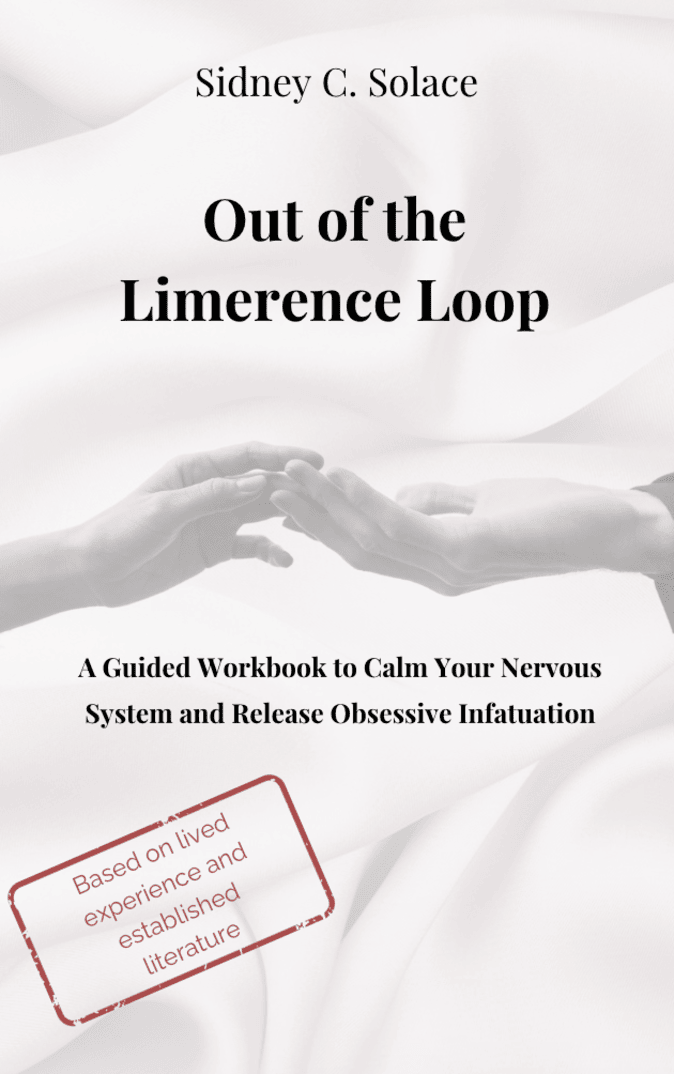
That's exactly what I made my workbook for. The exercises in Out of the Limerence Loop are intentionally designed to address this “addiction cycle” on different levels: some focus on the body through the senses, anchor phrases, and returning to the present; others use language and reflection to help you notice recurring patterns and the triggers behind your highs and lows; and others offer small, repeatable steps that bring structure to your day.
In the workbook, you can:
- Learn to name what is happening in the present, helping you bring your attention back to the here and now rather than getting caught up in fantasies and imagined scenarios.
- Map out your own triggers, highs and lows, and recurring patterns, rather than only understanding them in theory.
- Practise using anchor phrases and small daily choices to bring your attention back to your own life.
My book consists of two parts. In the first part, I explain in simple terms what limerence is, the patterns underlying it, and how it differs from ordinary infatuation. Just knowing what you're dealing with can make many people feel they're not crazy and that they're not alone in their experiences. However, simply knowing the theory is usually not enough to get out of limerence. Insight helps you to understand yourself better, while the exercises in the workbook help you to translate that insight into different behavior step by step, leading to more presence in your own life and more peace in your mind and body.
Not every exercise will suit everyone; that’s why you can take your time exploring what helps you move away from those familiar patterns. In my book, I work on two levels: cognitive (insight and words to help you understand your experience) and physical (exercises using your body and senses to help you feel more present and manage the stress that can come with limerence).
FAQ: Limerence and Addiction
Is limerence a real addiction?
Limerence is not an official addiction diagnosis, but it does activate the same dopaminergic reward pathways as substance and behavioral addictions and can exhibit the same patterns of highs, lows, cravings, and relapse.
Why does my phone feel so addictive in limerence?
Your phone offers constant opportunities to look for contact or a new signal from the other person. The cycle of hoping, checking, relief, and disappointment can make it difficult to put down.
Does this mean I have a “weak character”?
No. Addictive patterns stem from a combination of neurobiology, learning experiences, attachment, and coping, not from “weakness” or “ill will.” It does require responsibility to recognize what it is doing and to work with it step by step.
Does treating limerence purely as an addiction (like going cold turkey) help?
For some, sharp no contact works as part of recovery, but because limerence also has to do with attachment and trauma, just “cold turkey” is often not enough; it also requires emotional processing and building other sources of safety and reward.
How can your workbook help with this addiction side?
In my workbook, I draw on insights from addiction and trauma research to help you recognise your own triggers, highs and lows, and recurring patterns. The exercises help you practise making different choices step by step: checking less, finding other sources of reward, and being more present in your own life. It's a practical way to turn insight into manageable daily steps—not to punish yourself, but to help you regain a sense of choice and bring your attention back to your own life.
About the author

I’m Sidney, a writer and the person behind Sid’s Saferoom. I draw on years of personal experience with limerence, and I’m a certified trauma-informed coach (IPHM-accredited through The Complete Approach).
Knowing firsthand how lonely and exhausting obsessive infatuation can be, I dedicate my work to helping others heal. I write about it and developed the theory and workbook Out of the Limerence Loop. My mission is to provide you with the psychological insights and practical tools needed to interrupt the obsessive loop and restore peace to your nervous system.
- Want to know more? Read my full story on the About Me page.
- Weekly support? Subscribe to my English-language essays at substack.com.