

In this article, you'll read about the things you often don't see during limerence, but that are very clear in retrospect: how much you give, how little you get back, how often you are in your thoughts, and how much impact that has on the people around you. It's not about blame, but about awareness: seeing what's happening so you can make choices that are good for you and your relationships again.
I'm also writing this from personal experience. During periods of limerence, I noticed how my attention increasingly revolved around one person and how my husband and friends felt that I was physically present, but my mind was elsewhere. Many of these patterns originated from old loyalty and attachment themes, but that didn't lessen the impact on my surroundings; in fact, that realization later became a significant motivation for me to provide others with honest, relatable information and practical tools about this.
If you don't know exactly what limerence is yet and want to read more about it, check out, Limerence is an intense state of infatuation or obsession with another person. It's characterized by intrusive and persistent thoughts about the object of affection, an intense desire for reciprocation, and mood swings dependent on the perceived response of the other person.?
10 Valuable Insights in a Free Guide
Some people who land on this page have googled limerence tens of times. You know the definition. You know the stages. But there's a big difference between knowing what it is and actually getting out of it. I wrote a free guide with 10 insights that go a bit deeper. A guide that can help you on your way and explain that you are not alone.
You don't realize how much you give (and how little you get back)
A characteristic of limerence is that you start to see your limerent object as the center of your universe. You do a lot for the other person: thinking along, listening, being ready, arranging things, always being available.
This is what it can look like:
- You adjust your schedule so that you are “coincidentally” available when the other person needs something.
- You send long messages, but get short, delayed replies.
- You think about the other person's problems and invest a lot of emotional energy in them, while your own life takes a backseat.
In the literature on limerence, it is described that people in this state are often willing to make great sacrifices just to remain close to the other person. You no longer perceive well whether there is balance; as long as you receive a little attention or hope, it already feels like enough.
If you want to investigate whether you are in the middle of this, it can help to also look at the basics: in my blog What is limerence? I'll explain what limerence is and how it differs from regular infatuation.
Your surroundings notice your absence before you do.
One of the things that many partners, friends, and children describe is that someone experiencing limerence is there, but at the same time isn’t. You’re sitting at the table, you hear the words, you nod, but part of your brain is preoccupied with a conversation you had earlier, a message that might still come, or a scenario playing out in your head.
People around you can notice that:
- you find yourself saying “hmm” or “right?” more often without really responding;
- you have a harder time remembering other people's stories;
- You get irritated more easily when people ask “too much” of you while you’re already exhausted inside.
That’s especially painful when you’re actually a loyal and caring person. Much of this behavior stems from past loyalties, trauma, or attachment issues, but those around you can still sense that they’re reaching you less and less.
Inside your own head, you might be thinking: “I'm doing my best, I am present, aren't I?” It's often only later that you see how big the gap actually was.
Are you aware of your limerent behavior and do you recognize that you feel ashamed of how differently your infatuation plays out compared to others? Limerence and shame read more about it there. In Limerence and deep shame do I also describe how limerence sometimes focuses you so much on being chosen by your LO that you notice you are less present with your partner, children, or friends, and how you can deal with that realization.
Your life takes place in your head and on your smartphone.
Limerence and smartphones reinforce each other. Your phone is a direct line to the other person: messages, social media, email, notifications. Just having your phone nearby can reduce your attention and concentration; research shows that a phone on the table is enough to increase mind-wandering and distraction.
With limerence, you often see that:
- you check your phone much more often than you'd actually like to;
- you're still scrolling in bed, hoping to see something from the other person;
- interrupts your usual activities (reading, watching TV, talking) to “take a quick look.”.
As a result, your life increasingly becomes an inner world of scenarios, fantasies, and moments of self-reflection. The little things you used to enjoy—a walk, a conversation with your partner, playing a game with your child, a cup of tea—fade into the background.
If you notice that your head is also filled with repetitive, intrusive thoughts about this person, then it's a good idea to also read my blog about iIntrusive thoughts in limerence to read; in it, I explain how these kinds of thoughts work and what steps can help you clear your mind a little more.
Sometimes you only realize later that your limerence is entirely focused on someone you'll never actually meet, like an actor or musician; in Limerence for a movie star or pop star Let's see what that looks like.
And when you notice that your reaction to a trigger is much greater than the situation itself, it can help to Limerence and attachment styles to investigate which old attachment wounds play a role here.
You call it love, but you've lost yourself along the way
On the inside, it often feels like love—sometimes even like “true love that no one else understands.” At the same time, if you take an honest look, you’ll see that your own life is getting smaller and smaller:
- You base your self-worth on the attention of this one person.;
- you adjust your dreams, plans, and energy based on what they do or don't do;
- You push yourself beyond your limits just to “not ask too much” or to remain available.
Psychologists often describe limerence as an addiction-like pattern: you get highs from contact and hope, and crashes from distance and silence. In such a dynamic, it makes sense that you lose yourself along the way.
If any of this sounds familiar to you, it might be helpful to check out my blog as well Limerence and boundaries: when it hurts your life to read, in which I'll delve deeper into shifting boundaries and their concrete impact on your daily life.
Sometimes you only realize late that a friendship is actually limerence. Limerence in friendship: obsessively in love with a friend Do you find recognition when that's going on with you.
When your mind keeps going back to what your physical education teacher does, means, or perhaps feels, it can figure out what you actually need be a first step to gently bring your attention back to yourself.
To think about yourself
These questions can help you look at where you are now without judgment:
- In what ways do you notice that you give more than you get in return—in terms of time, attention, and emotional presence?
- Who in your circle has recently suggested that you’re “not quite there”? How did that make you feel?
- On an average day, how much time do you spend on your smartphone because of this person, and how much does that cost you in terms of time you could be spending on other things?
- What small things used to make you happy that you do less now because your mind is mostly on the other person?
- What would you wish for your future self: how do you want yourself and your surroundings to look back on this period in a few years?
Just this one more thing
Limerence doesn’t mean you’re a bad person or that you’ll never be able to experience healthy love again. It means that a part of you is trying very hard to get (or hold on to) something that was once unsafe or uncertain, and that your brain has chosen a path that, in the meantime, is costing you more than it’s giving you.
You can learn to recognize that route, get curious about what you are so deeply seeking in this person, and step by step create more space again for yourself, your relationships, and your own life.
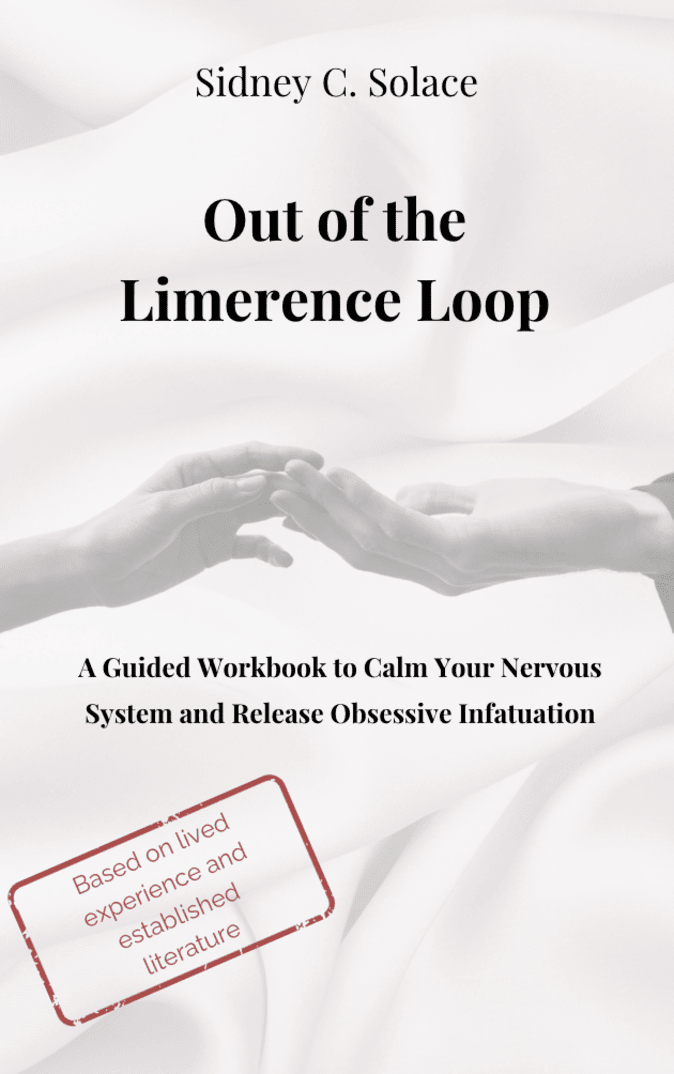
In my workbook on limerence, I have brought together the exercises that helped me and others spend less time living in our heads with one person and more time returning to our own lives: reflections, trigger exercises, and small, doable actions that can keep pulling you out of the loop of thinking and checking. It is not a quick fix, but a roadmap; if I was able to find more calm and presence, you can trust that the same path also exists for you, at your own pace.
FAQ about things you don’t even notice you’re doing while in limerence
How can I tell if this is limerence or just normal falling in love?
With limerence, so much of your attention and self-worth can end up revolving around one person, fueled by fantasy, intrusive thoughts, and big emotional highs and lows from small cues. Healthy love leaves more space for you, your own life, and other relationships — it tends to feel steadier, safer, and more reciprocal.
Is it normal that my partner or friends say I seem “checked out”?
Yes, this is very common with limerence. People around you may notice that you are distracted or “not fully present,” because a lot of your attention is tied up with the limerent person and with checking your phone. It can really hurt to hear that, but it is also a gentle alarm bell that limerence is starting to impact your relationships.
How much smartphone use is “too much” when it comes to limerence?
There is no perfect number of minutes or checks per day, but it becomes “too much” when phone use around your limerent person starts to interfere with your sleep, work, or relationships, or when your mood rises and crashes based almost entirely on notifications. If you find yourself constantly checking your messages or their social media and struggling to focus on anything else, that is a sign that limerence is driving your phone use rather than simple curiosity. In the workbook, you learn to track these checking habits and gently reduce them step by step, instead of trying to go from “all the time” to “never” overnight.
Am I dishonest or a bad person if my mind is so often with someone else?
Your intention is often not to hurt anyone; many of these patterns grow out of attachment, trauma, and old loyalties. At the same time, it is honest to acknowledge that the people around you are affected, and that it can be an act of love to take responsibility for how present you are.
Can I change this on my own, or do I always need therapy?
Some people get quite far with self-reflection, good information, workbooks, and support from the people around them; others benefit from therapy, especially when old trauma and strong anxiety are involved. In both cases, it helps not to rely on willpower alone, but to use a structure of small steps and practice, which is exactly why the Out of the Limerence Loop workbook puts so much emphasis on concrete, manageable exercises to gradually reclaim more space in your life.
About the author

I am Sidney, writer, researcher, and the driving force behind Sid's Saferoom. In addition to my years of personal experience with breaking free from limerence, I am certified Trauma-Informed Coach (IPHM-accredited via Kirsty Watson, The Complete Approach).
Knowing firsthand how lonely and exhausting obsessive infatuation can be, I dedicate my work to helping others heal. I write about it and developed the theory and workbook Out of the Limerence Loop. My mission is to provide you with the psychological insights and practical tools needed to interrupt the obsessive loop and restore peace to your nervous system.
- Want to know more? Read my full story on the About me-page.
- Weekly support? Subscribe to my English-language essays at substack.com.