

In this article, you'll read why shame can become so deeply intertwined with limerence, especially when you're “just” functioning on the outside.
You discover what it feels like when your crush unfolds very differently from those around you, why you quickly start to see yourself as dreamy, weak, or strange, and what first gentle steps help you to look at yourself more humanely.
We delve into how shame often deepens your limerence patterns rather than shrinking them, and how you can move step by step from “there's something wrong with me” to “there's a human pattern that needs attention”.
10 Valuable Insights in a Free Guide
Some people who land on this page have googled limerence tens of times. You know the definition. You know the stages. But there's a big difference between knowing what it is and actually getting out of it. I wrote a free guide with 10 insights that go a bit deeper. A guide that can help you on your way and explain that you are not alone.
What happens when you feel “different” when in love than others
Many people with limerence feel early on that their infatuation is unlike what they see in others. While friends may be infatuated for a while, then move on and divide their attention, you find that your head seems to get stuck somewhere.
You can notice things like:
- Others call you a dreamer, absent, or difficult to reach.
- You catch yourself only half-listening or not listening at all during conversations.
- you notice that your attention, even during busy periods, keeps drifting back to one person
- You feel that your infatuation is longer, more obsessive, or more all-consuming than “normal.”
Because you don't have clear language for what's happening, it's logical that you'd start comparing yourself. You see others seemingly experiencing their crushes within a certain range, while your system reacts much more intensely and for longer. That alone can already evoke shame: the feeling that you are fundamentally different from others in a key way and that you have no words or place for it.
In What is Limerence I'll give you the basic definition of limerence: an obsessive, lovesick-like form of infatuation, with a strong emphasis on hope, fantasy, and intrusive thoughts. This blog specifically focuses on the layer underneath: the shame that arises when that form of infatuation doesn't fit the image you have of yourself.
If you have ADHD, you might feel extra ashamed of how intensely you react to limerence: you feel a lot, you think a lot, and you can't seem to let go in a “normal” way. Limerence in ADHD addresses that combination and helps you look at yourself more gently.
My experience: a dreamer, absent-minded, yet functional, with a secret life in my head
In my own life, I've often noticed that people saw me as a dreamer. Someone who was difficult to reach, who sometimes seemed to be only half-listening or not listening at all. Often, this was because I was deep in thought about my LO, while on the outside I was simply present in a conversation, a work situation, or a social setting.
Early on, I had the feeling that there was something different about my infatuation compared to that of many people around me. While others would have a crush and then move on, I noticed that my thoughts were sometimes completely consumed by one person for 80% of the time. Not just in the early stages, but over the long term, filled with fantasies, hopes, and inner monologues.
When I discovered the word “limerent,” it felt like a relief on one hand; finally, a term for what I had experienced all these years. On the other hand, it also evoked shame. People who, objectively, I wouldn't necessarily give a significant role in my life were given immense status internally. I was ashamed of that, especially because I otherwise went through life very independently: I arranged things, took responsibility, made choices. That intense, obsessive part seemed out of sync with the image I had of myself as a capable, rational person.
Precisely that tension, between how you feel internally and how you want to see yourself, is a significant source of shame in limerence. That's exactly why I started writing about it and created my workbook: because I realized that you not only need an explanation of limerence itself but also a gentle perspective on what it does to your self-image.
In Limerence and deep shame: when your desire clashes with your values Will I address what happens when you notice that your limerence sometimes pulls you further than your own standards and integrity are comfortable with?.
Why limerence evokes so much shame
Shame is a feeling that says, “There's something wrong with me” instead of “There's something difficult about what I'm doing or experiencing.” In limerence, that shame can arise in different places:
- Shame about your inner world
You feel ashamed because your mind is so focused on one person, often someone who objectively doesn't play a significant role in your life. A colleague, teacher, therapist, acquaintance, celebrity, someone you barely know. It feels like your inner world disproportionately revolves around them. - Shame about your behavior
You are ashamed of your checking behavior, fantasies, inner dialogues, the fact that you are absent in conversations or tasks. Perhaps also of decisions you have made under the influence of limerence: texts, emails, meetings, flirting, or boundaries you have stretched. - Shame because it doesn't fit your identity
If you function independently in other areas – work, study, family, finances – limerence often feels like a “strange attachment” to your personality. You see yourself as rational, responsible, perhaps even down-to-earth, and that's precisely why this intense, obsessive side doesn't fit the picture. This can lead to deep shame about your identity, as if there's a part of you that isn't allowed to exist.
In addition, limerence often touches on old layers of self-worth and attachment. If somewhere in your history you were told that your desires are “too much,” that you are too sensitive, too romantic, too intense, or “pushy,” then limerence can feel like proof of that. Your shame will then color not only this one situation, but your entire idea of yourself.
Blogs as Limerence: what you don’t see when you’re in it en Limerence and attachment styles help you see that there is a psychological context for this intensity, and that it doesn't mean that you as a person are “wrong.”.
How shame can draw you deeper into limerence
The painful thing is that shame often doesn't help to reduce limerence, but rather to increase it. A few ways this happens:
- You are going to hide your inner world.
Because you feel ashamed, you say little or nothing about what's really going on in your head. You keep it to yourself, don't talk about it, and don't seek support. This also means you get fewer reality checks: no one saying “this sounds like limerence,” no one normalizing it or brainstorming with you. - You become more isolated with your thoughts.
As soon as shame says “this should not exist,” your inner world becomes something that can only live at night, in silence, within your own head. This allows for more time and space for fantasy, inner conversations, and the repetition of scenarios, without new experiences to counter them. - You're going to punish yourself instead of helping yourself.
You're trying to “push away” your limerence by being strict: “I have to stop this, I'm weak, I have to be normal.” That feels like discipline, but often works as extra pain. Instead of helping yourself, you're breaking yourself down, which gives your system even more tension and sadness – and therefore even more of a drive to reach for your LO for comfort. - You'll start to doubt if your pain is “real.”
Shame makes you wonder, “Do I even have a right to grieve and recover? This wasn't even an official relationship, it was just a crush, others have it worse.” As a result, you deny yourself the space to cry, process, and ask for help. The consequence is that you remain stuck in a half-processed story.
In Limerence is similar to addiction Let me show you that limerence has many characteristics of an addiction-like loop, without it being a “lack of character.” If you let that sink in, it becomes a little easier to see that shame is an understandable reaction, but not necessarily a reliable source of truth about your worth.
First gentle
You don't have to stop feeling shame all at once. Sometimes the process begins with a few very small shifts in how you see yourself. A few possible micro-steps:
- Put into words what is happening
The word “limerence” can be helpful, as long as you use it as a description, not a judgment. For example, say: “This is limerence, an intense, obsessive pattern. That doesn't mean I'm weird, but that I'm experiencing something others know too.” - Differentiate between feeling, behavior, and identity.
Your feelings (longing, missing, pain, hope) are human. Your behavior (e.g., texting, checking, fantasizing) can be examined and adjusted. Your identity—who you are—is more than this one experience. By separating these three, you prevent shame from conflating everything. - Create one safe space where you are allowed to say this
That can be therapy, a good friend, a community, or even a journal where you don't try to be “neat.” A place where you can write down sentences like, “I'm more invested in this person than I want to be” without immediate judgment. - Practice small moments of self-compassion.
Self-compassion isn't a grand gesture, but a small phrase or gesture towards yourself. For example: “It makes sense that I'm reacting this way, given what I've been through.” Or: “I'm someone who feels intensely; that's sometimes difficult, but it's also part of my humanity.” - See shame as a signal, not a verdict.
Shame says, “Here is something vulnerable.” It doesn't have to say, “Here is something wrong.” If you can see shame as a light that turns on at a sensitive spot, you can approach yourself with more gentleness. That makes it easier to allow support and help.
Blogs as Limerence and Boundaries: When It Hurts Your Life en Intrusive thoughts in limerence provide extra language for those moments when shame arises because limerence is starting to visibly affect your behavior and daily life.
How my workbook can help when you feel ashamed of your inner world
Shame often requires your inner world to remain invisible. You don't show how deep the limerence is, you don't tell everything, you keep the worst thoughts to yourself. A blog can then be a first safe place: someone telling you that you're not crazy or bad for being obsessively in love.
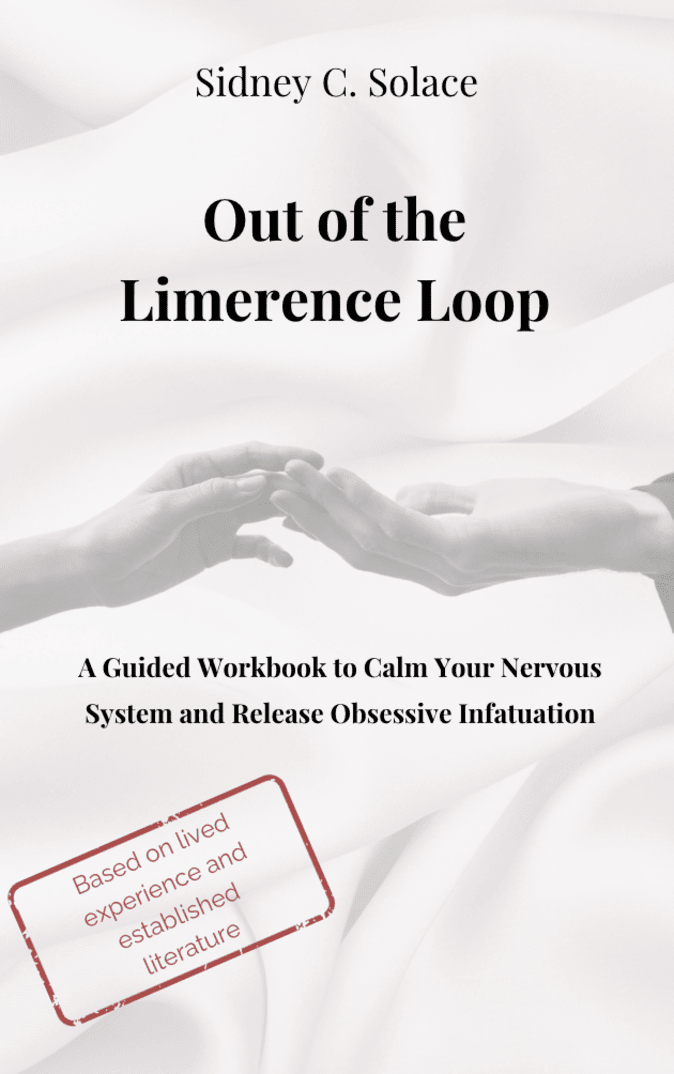
For many people, it's then helpful to have a place where they can work with that inner world step by step, without having to judge themselves. That's why I have my workbook “Out of the Limerence Loop.” written: not to “fix” anyone, but to offer language and exercises through which you can calmly explore your own patterns, shame, and desires.
In the workbook, you will find space to:
- to write your personal limerence story without immediately having to “downplay” it
- to see which old messages about yourself (for example, “I'm too much,” “I'm not good enough”) are playing a role
- to learn to look at your own intensity more mildly
- Concrete steps you can take to loosen up without first having to be perfectly uninhibited
If you want to tackle this step by step, my workbook will help you go through these processes calmly and in a structured way. This blog is primarily intended as a safe first step, with recognition and language for what you are feeling.
To think about yourself
Perhaps it helps to gently ask yourself one or two of these questions:
- What do I feel most ashamed of: my feelings, my behavior, or my self-image?
- What sentences about myself come up when I think about my limerence? (For example: “I'm weak,” “I'm weird,” “I'm wrong.”)
- Who do those sentences seem to originally come from – myself, my surroundings, older experiences?
- How would I view a good friend going through the same thing as me, and what does that say about the gentleness I still need to learn to give myself?
You don't need to have perfect answers to these questions. Just seeing that these questions exist is an important step in shifting your perspective from “I am wrong” to “I am someone going through something intense.”.
You are not a bad person because you are limerent, and you are not broken because your infatuation takes a different turn than others. Limerence is a complex pattern, but it is something that can be understood and influenced. Shame may be a part of it, but it doesn't have to remain the director of your story. Small steps, a lot of gentleness, and gradually a bit more room for your own humanity – that's truly enough to start with.
FAQ – Questions about Limerence and Shame
Is shame normal in limerence?
Yes, many people experiencing limerence feel shame precisely because their infatuation is more intense and obsessive than what they observe in others. That doesn't make you bad; it means you have a vulnerable spot that needs attention.
Am I a bad person if I'm this obsessively in love?
No. Your behavior can sometimes be hurtful to yourself or others, and you can take responsibility for that. But the feelings themselves don't make you bad; they tell you something about your desires, pain, and history.
Do I always have to tell others about my limerence?
No. You get to decide who you share this with. It can be helpful to have one or two safe people, a therapist, a friend, a partner, with whom you don't have to pretend it means nothing, and with whom you can talk about your shame and struggles.
Does shame go away once limerence stops?
Sometimes shame lessens as obsession decreases, but old shame patterns can persist. Therefore, it is valuable to work not only on limerence itself, but also on your self-image and self-esteem.
How can I see a therapist about this without being mortified?
You can say it as simply and honestly as possible: “I've been obsessively in love with someone and I'm very ashamed of it. I notice it's taking up a lot of space in my head and life, and I want to understand it better.” A good therapist won't judge you for your feelings, but will look with you at how you can deal with them.
About the author

I am Sidney, writer, researcher, and the driving force behind Sid's Saferoom. In addition to my years of personal experience with breaking free from limerence, I am certified Trauma-Informed Coach (IPHM-accredited via Kirsty Watson, The Complete Approach).
Knowing firsthand how lonely and exhausting obsessive infatuation can be, I dedicate my work to helping others heal. I write about it and developed the theory and workbook Out of the Limerence Loop. My mission is to provide you with the psychological insights and practical tools needed to interrupt the obsessive loop and restore peace to your nervous system.
- Want to know more? Read my full story on the About me-page.
- Weekly support? Subscribe to my English-language essays at substack.com.