

In this article, you can read about what limerence is (obsessive infatuation), how to recognize it in your thoughts, emotions, and body, what often underlies this dynamic, and why the question “how can you stop limerence?” isn't easy to answer, but can be a starting point for recovery..
All articles mentioned in this article can also be found here in the overview: “everything about limerence.”
You live your life, do your work, talk with friends.
But beneath it all lies one constant: that one person. Everything they do or don't do determines your mood. Your phone is constantly nearby, conversations are reread and every sign is analyzed, while somewhere you know this is no longer “just being in love.”.
The condition has a name: limerence.
In this blog, you'll read what limerence is, how it feels, how to recognize it, and why the question “how can you stop limerence?” isn't just a matter of willpower, but of understanding what's happening in your head and nervous system.
The word limerence was introduced in 1979 by psychologist Dorothy Tennov. In The first important book about limerence: what Dorothy Tennov taught us read why her book still offers so much recognition.
If you want to understand why limerence is not just strong feelings, but also a pattern of continued hope, checking, and interpretation, also read The limerence loop. There you see how uncertainty and small signals from a LO can together form an emotional loop that's hard to escape.
10 Valuable Insights in a Free Guide
Some people who land on this page have googled limerence tens of times. You know the definition. You know the stages. But there's a big difference between knowing what it is and actually getting out of it. I wrote a free guide with 10 insights that go a bit deeper. A guide that can help you on your way and explain that you are not alone.
What is limerence, actually?
Limerence is a term for an intense, involuntary obsession with one specific person, where you become emotionally dependent on their attention and reaction. It goes beyond infatuation: your inner world becomes fixated on the other person, while the reality of the contact is often much less significant than what you experience internally.
If you notice that your limerence primarily revolves around unrequited or unattainable love, then also read Limerence and unrequited love for more explanation about why those particular situations trigger so much in you.
Typical elements of limerence include:
- A continuous mental preoccupation with the other person (you think about them all day long).
- A strong yearning for validation and reciprocity.
- A tendency to idealize and romanticize others.
- Large emotional swings depending on small signals.
So it's not an official diagnosis, but a psychological state which can have an enormous impact on your daily life in practice. Perhaps you recognize not one, but multiple periods of intense, one-sided infatuation in your own history. In When limerence seems chronic: from one obsessive crush to the next read what it means when limerence runs through your life like a common thread, and why that doesn't mean you're ‘broken’.
In Limerence in ADHD read how a busy, sensitive brain can make these feelings extra intense.
If you want to know how to stop this? In How to stop Limerence: Why Letting Go Is So Difficult (and What Actually Helps) reads more about recovery, relapse, and first small steps. And you can start with two simple exercises in Two exercises that interrupt limerence.
Do you notice when reading this article that your infatuation feels different and perhaps “too much” compared to others? In Limerence and shame Read about how that shame arises and how you can look at yourself more kindly.
If your limerence plays out in a friendship, you'll recognize a lot in Limerence in friendship: obsessively in love with a friend.
If you notice that limerence is causing your boundaries to slowly shift, read on. Limerence and boundaries: why recovery goes against your tendencies how to start practicing small, achievable boundaries.
What does limerence feel like on the inside?
On the outside, you might look perfectly normal. You go to work, crack jokes, and do what needs to be done. The hidden side plays out in your mind and body.
Many people describe, among other things:
- Restless Mornings – The other person is the first thing on your mind as soon as you wake up.
- Emotional highs and lows – A quick text can make your day; silence can feel like a crash.
- Physical tension – a stressed body, chest tightness, poor sleep, being “on.”.
- A constant movie in your head – replaying conversations, brainstorming scenarios, sketching out future moments.
- Shame and secrecy – you find your own intensity excessive and therefore talk about it little.
You can feel that you rationally know it's not healthy, but that you are emotionally and physically still trapped in the same loop.
Would you like to know the difference between limerence and regular infatuation? Read this article.
If you find that the description of limerence here resonates with you, it might be helpful to read further in a few in-depth articles. In the blog Intrusive thoughts in limerence I’ll take a closer look at what happens when your mind gets fixated on one person and the same thoughts keep repeating themselves, and how you can create more space for yourself, step by step. If you’re wondering, above all, when limerence is no longer “just intense” but is really starting to hurt your life, then you’ll find in Limerence and boundaries: when it hurts your life examples of shifting boundaries, impact on work and relationships, and first achievable boundaries you can practice. And if you want to see which things you often only recognize in retrospect, such as how much you did for others, how much your environment missed you, and how often you were lost in thought or on your smartphone, then close limerence: what you often don't realize while you're in it There, beautifully done.
Recognizing limerence is often an important first step, but it can also be difficult: only then do you begin to see how often your mind automatically goes back to your LO. In Recognizing limerence: why the first stage of recovery is so difficult read why that is not a sign of failure.
Sometimes limerence is not only about attraction or longing, but also about an older desire to be seen, reassured, or chosen; in Limerence and emotional neglect you read how childhood experiences can play a role for some people.
Sometimes it's even an “unknown”
If you notice your limerence is primarily focused on a movie star or pop star, it helps to read about how fantasy, posters, concerts, and parasocial relationships play a role in this on the blog. Limerence for a movie star or pop star.
And if you want to understand why limerence strongly coincides with your youth and past relationships, then you can in Limerence and attachment styles further investigate how anxious, avoidant, and disorganized attachment fuel the fire of obsessive infatuation.
Limerence with your ex
Did you end the relationship yourself with the person you experienced limerence with? Then it's very normal to not only think about someone a lot, but also to have endless conversations with him or her in your head. Why you keep having conversations in your head with your ex Read why that feels so persistent with limerence and what you can do about it.
Limerence and the line between infatuation and obsession
Falling in love can also be intense: thinking about someone a lot, butterflies in your stomach, excitement. The difference from limerence lies not only in the intensity, but in the degree of loss of control and the role of uncertainty.
When it comes to limerence, for example, it's characteristic that you endlessly try to understand and analyze your person. In Why you try to understand everything about that other person I give words to that puzzle in your head and how you can bring the attention back to yourself.
In any case, you often see a few important differences between obsessive and ordinary infatuation:
- When falling in love, your system often calms down once there is clarity, safety, and reciprocity.
- In limerence, restlessness is fueled by ambiguity, mixed signals, and unattainability.
- When you fall in love, your own life usually stays more or less intact.
- With limerence, you quickly go beyond yourself, your boundaries, and your daily functioning.
As a result, limerence feels less like a “strong feeling” and more like a pattern where you can get stuck.
Are you especially wondering why you're so stuck on this particular person? In this article, I will delve deeper into why precisely he or she is such a strong trigger for your limerence. If you want to better understand why uncertainty and mixed signals hit you so hard, read on in Limerence and anxious attachment how anxious attachment and limerence reinforce each other.
No contact with your limerence object is one way to set boundaries, but sometimes professional help is needed. Limerence Treatment: What Help Is Right for You? find more about therapy, coaching, and self-help.”
Neurochemistry of Limerence
Neurochemically speaking, limerence has many similarities to addiction; I'll tell you more about that in the blogs below.
If you want to read how limerence can change your phone usage into endlessly checking ‘last seen’ and reading blue ticks as code, then it helps limerence and you Smartphone to better understand that piece. For a deeper explanation of why limerence is so similar to addiction, with highs, lows, and cravings, you can read further in Limerence is similar to addiction.
How can Limerence arise?
There isn't one single cause, but rather several factors often come together:
- Uncertainty and mixed signals
Unpredictability – sometimes warm, sometimes distant – acts like a psychological slot machine. It's precisely the irregular reinforcement that makes the brain extra alert and sensitive. - Projection and fantasy
The other person is not only seen as an individual but also as a bearer of hope, fulfillment, or salvation. Your brain attaches a narrative to it about all the things this relationship could possibly resolve. - Old patterns around attachment and being chosen
Research into attachment styles shows that a significant portion of people are insecurely attached; this group is more prone to extreme separation anxiety, obsessive infatuation, and clinging to unattainable partners.
Limerence can then feel like a repeat of an old theme: finally wanting to be chosen. - Neurochemistry and expectation
Substances like dopamine play a big role in anticipation and reward. Not just the contact itself, but especially the expectation that something is going to happen can provide a strong “high” – with a corresponding crash if it doesn't materialize.
This mix makes limerence so persistent: it's not “just in your head,” but a combination of psychological and physical processes. Do you notice that keeping distance or having less contact with your limerence person doesn't actually work, no matter how hard you try? In this article, I will explain What no contact in limerence is and why distance feels so difficult
Limerence is often not just about being in love, but also about what you hope to feel through that one person; in Limerence and needs: what do you really need? read how you can gently explore that underlying desire.
How to stop limerence
De vraag “hoe kun je limerence stoppen?” is begrijpelijk én belangrijk. Veel mensen zijn op het punt dat ze voelen: zo wil ik niet nog jaren doorgaan. Tegelijk is limerence geen schakelaar die je met één inzicht uitzet.
What does help as a start:
- Understanding what limerence is, so you no longer romanticize it as proof of unique love but recognize it as a pattern you can grow out of.
- Seeing that your brain and body are involved, and that “just stopping” often doesn't work without conscious changes in attention, boundaries, and how you deal with urges.
- Recognizing that you are not alone in this – large numbers of people worldwide are now searching for terms like “limerence” and “obsessive infatuation.”.
Real change, then, requires daily, concrete steps: a different approach to cravings, a different perspective on connections, a different way of dealing with yourself in difficult moments. That goes beyond a single blog post.
Many people want to know: “How long is this going to last, for heaven's sake?” If you feel like you're no longer in control of your own thoughts and like you're in a mental prison, it's perfectly logical to seek solace in time. Research and clinical descriptions of limerence show that a limerent episode can often last from months to a few years, with an average estimate around 1.5 to 3 years; for some people, it fades faster, while for others, it lingers much longer. In a separate article, I will briefly explain How limerence arises and what we know based on research and practical experience about its typical duration and the factors that cause it to linger shorter or longer; I refer to these in this blog.
Limerence while in a relationship
For many people, limerence doesn't just play out when they're single, but precisely while they already have a partner. You can be deeply in a relationship and still notice your thoughts, hopes, and fantasies fixating on someone other than your partner, sometimes with whom you have limited or even no real contact. This is alarming because it feels like inner infidelity, even when rationally you might not want to leave your relationship at all. In literature and practice descriptions, you see this occurs more often than people think: limerence can put existing relationships under pressure, but it doesn't automatically mean you're a bad person; it primarily shows how powerful this obsessive infatuation can hijack your attention. In the separate blog about limerence with someone other than your partner I'm going to delve deeper into that situation: what exactly happens then, why it feels so intense.
If you find that limerence doesn't stop once contact is over, but instead your mind keeps replaying things and having internal conversations, then also read Limerence and closure: when your mind won’t let go after the contact ends.
Herstellen van Limerence
Herstel van limerence betekent niet altijd dat je LO meteen uit je hoofd verdwijnt; in Het begin van herstel bij limerence lees je hoe gedachten minder macht kunnen krijgen, ook wanneer ze nog geregeld opkomen. In het artikel “Love and Life After Limerence” I will write more about the final phase.
Getting over limerence
This blog can give you your first recognition and language, but it is only a beginning.
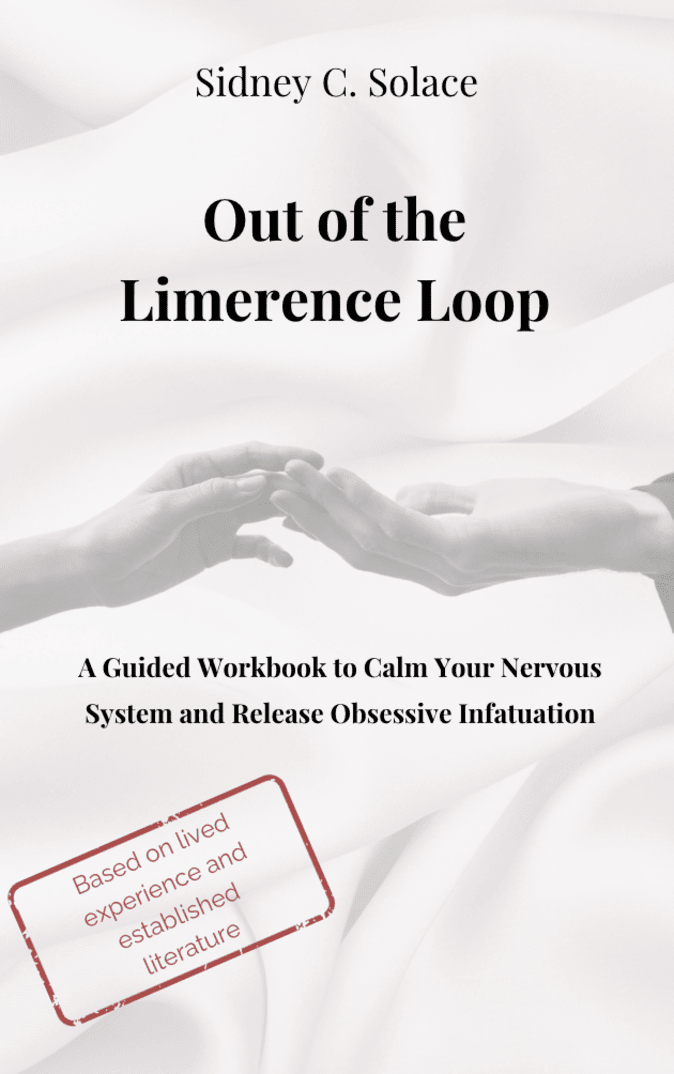
In "Out of the Limerence loop", the theory and Workbook, for those stuck in obsessive infatuation, I dive deeper in;
What exactly happens in your brain, body, and relationships
How youth, attachment, and old patterns play a role in this extreme fixation
Why uncertainty and unattainability make the limerence loop so persistent
And what you need in everyday life to come back to yourself step by step.
This book is written for people who appear to function normally on the outside, but who feel, deep down, that one person has taken over their entire being.
If you feel that you want to go beyond simply understanding what limerence is and explore how you can break that cycle in your own life, then this book is for you.
Frequently Asked Questions About Limerence
Is limerence a mental disorder?
Limerence is not an official diagnosis, but a term introduced in the 1970s by American psychologist Dorothy Tennov for her book Love and Limerence: The Experience of Being in Love (1979). She used it to describe an intense, involuntary obsession with one person, in which idealization and dependence on validation are central.
Can limerence fade?
Yes, limerence can fade over time, but it usually requires awareness and breaking persistent mental and relational patterns, sometimes with help. Limerence can eventually pass for a person, but without addressing the underlying causes, a new person may enter your life who acts as a limerence trigger.
Can limerence also occur when you barely know someone?
Yes, limerence often occurs with people with whom there is little or intermittent contact; the intensity then arises primarily in your inner world through fantasy and projection. It can even be someone you don't know, like a pop star.
Is limerence the same as love or a normal crush?
No, ordinary infatuation usually remains manageable, while limerence feels like an obsessive pattern that takes over your thinking, feeling, and functioning.
Is limerence the same as ‘love addiction’?
There is overlap, but love addiction revolves more around repeatedly seeking romantic highs, while limerence specifically concerns fixation on one limerent object.
How to stop limerence
There's no magic button; stopping limerence starts with understanding what's happening in your brain and relationships, and then step-by-step making different choices in attention, boundaries, and how you handle contact. And many exercises you'll find in “Breaking Free from Limerence.”
Am I ‘crazy’ if I recognize myself in this?
No, limerence indicates a combination of sensitivity, old patterns, and a nervous system that strongly reacts to uncertainty and validation, not “being crazy.”.
About the author

I am Sidney, writer, researcher, and the driving force behind Sid's Saferoom. In addition to my years of personal experience with breaking free from limerence, I am certified Trauma-Informed Coach (IPHM-accredited via Kirsty Watson, The Complete Approach).
Knowing firsthand how lonely and exhausting obsessive infatuation can be, I dedicate my work to helping others heal. I write about it and developed the theory and workbook Out of the Limerence Loop. My mission is to provide you with the psychological insights and practical tools needed to interrupt the obsessive loop and restore peace to your nervous system.
- Want to know more? Read my full story on the About me-page.
- Weekly support? Abonneer je op mijn Engelstalige essays op substack.com.