

In this article, you'll read why limerence is almost never random, how old pain, attachment, and unmet needs play a role in choosing your limerent object, and what that says about your triggers—not as blame, but as an entrance to understanding and healing.
One of the most frustrating questions with limerence is: Why this person specifically? Of all the people around you, it seems like he or she has a kind of magical attraction. It often doesn't feel logical. Sometimes the situation is totally unsuitable, sometimes the other person isn't available, safe, or “good for you” at all – and yet your system remains ‘on’ for this person.
If you're still unsure whether it's ordinary infatuation or limerence, you can read here first What is the difference between love and limerence
It sometimes feels as if fate, chemistry, or something intangible has decided this. But when you look at the psychological side, you see that there are usually patterns and triggers underlying it.
“Why this specific person?” feels like a mystery
Many people describe their limerent object (LO) as someone who stands out at first glance: charismatic, special, “different from others.” Yet it's rarely just about appearance or objective qualities. The LO often touches upon a combination of things:
- timing (for example, during a vulnerable or lonely period)
- the dynamics (distant, alternating, intriguing)
- something familiar in an inexplicable way
Perhaps you'll discover that it's not just about this one LO, but that you've been intensely obsessed with someone more often. In that case, you can When limerence seems chronic: from one obsessive crush to the next help you see your bigger picture.
That familiar feeling isn't always a sign of a healthy match. It could also be that this person unconsciously evokes something your system already knows from previous relationships or from your childhood, such as emotional distance, inconsistent availability, or the feeling that you have to prove yourself to be seen.
Herken je dat je steeds weer verliefd wordt op mensen die niet beschikbaar zijn, of jouw liefde niet beantwoorden? In Limerence and unrequited love schrijf ik daar meer over.
Trauma, attachment, and unmet needs
The literature on limerence and obsessive infatuation increasingly points to the role of attachment and past pain. Individuals with a history of emotional neglect, inconsistent contact, or insecure attachment appear to be more susceptible to intense, obsessive fixations on average.
This is not because there is “something wrong” with them, but because their system:
- highly sensitive to signals of attention and rejection
- carries old unmet needs (to be seen, to be chosen, closeness)
- and unconsciously tries to fulfill those needs through a new relationship or obsession
In that light, the question “why this person in particular?” becomes less mysterious. The LO often seems to possess traits, or offer a dynamic, that strikes precisely at that old need: a special kind of attention, a mix of warmth and distance, or the feeling that one could finally truly be seen.
Soms is jouw “waarom juist híj of zij?” extra pijnlijk omdat het steeds om mensen gaat die onbereikbaar of op afstand zijn, denk aan filmsterren of popsterren; daarover schrijf ik uitgebreider in Limerence for a movie star or pop star.
Als je merkt dat het antwoord op die vraag bijna altijd terugvoert naar oude hechtingspijn, dan helpt Limerence and attachment styles om dieper te kijken naar de patronen die onder jouw keuze voor LO’s liggen.
If you also notice that you're increasingly doing things for the other person, sacrificing yourself, and your surroundings can't reach you as well, then you probably recognize a lot in limerence: what you often don't realize while you're in it, where I further work out these blind spots.
What exactly ‘triggers’ you?
A trigger is a stimulus in the present that touches something old in your system. This can be a word, a look, or a behavior, but also an entire dynamic. With limerence, you see a few common triggers recurring:
- Unreachability
A busy, emotionally reserved, or hard-to-read significant other can awaken an old fear of not being chosen or not truly belonging. - Fluctuating attention
Alternating hot and cold behavior – one moment lots of attention, the next distance – can feel familiar if you grew up with unpredictable closeness. - Admiration and idealization
Love interests are often seen as special, talented, powerful, or broken in a way that you think you can understand or “save.” That can tap into an old need to be valuable yourself by fixing someone else. - Situations where you felt small in the past
Authority figures, older partners, people who represent something you never had – those can take on extra significance.
The point isn't that every detail needs to be psychologically interpreted, but rather that limerence is usually not a purely “random accident.” The choice of your LO often says something about which parts of you still feel young or old.
In my article about no contact with limerence and why distance is so difficult I will elaborate on what happens when you allow fewer stimuli from your limerent object.
Limerence says more about your inner world than about their ‘specialness.’
This can be a bit painful to read, as limerence often feels precisely like the ultimate proof that someone else is so special. But the intensity often comes just as much – or even more – from your inner world as from the other person:
- You project desires, qualities, and rescue fantasies onto the LO.
- You are making one person the carrier of a whole package of unmet needs.
- Your brain uses obsession as a kind of coping mechanism against emptiness, fear, loneliness, or trauma.
That doesn't mean your feeling is fake. It does mean that the meaning you attach to this person might be greater than what the actual relationship can bear.
Soms gaat limerence niet alleen over waarom juist déze persoon je raakt, maar ook over waarom je daarna in een cyclus van wachten, fantaseren en zoeken naar tekens belandt. In The limerence loop lees je hoe dat patroon zichzelf in stand houdt.
Why this is not a letter of debt, but a roadmap
Here, it's important not to fall into self-recrimination. The goal is not: “it's all your fault.” The goal is: You can also look at what limerence says about you, so you don't just keep pointing to that one person as the reason for your suffering.
When you see which pattern is active - for example, fear of abandonment, fear of getting too close, only feeling valuable when you rescue someone - then you have something you can actually work with. Limerence then becomes not just a nightmare, but also a signal: “there's something in me that needs attention here.”.
And when you notice your mind keeps returning to the same scenes, conversations, or fantasies with this person, you can Intrusive thoughts in limerence read how such thoughts work and what first steps help to get some peace in your head again
If you're wondering “what does this say about me?”
A few questions you could ask yourself (without getting into actual worksheets or exercises yet):
- What feelings or situations from my childhood seem to resemble what I'm experiencing now?
- What type of people keep attracting me – and what dynamic keeps repeating itself?
- What do I hope this person will solve for me, that is actually older than this encounter?
These kinds of questions aren't homework to “quickly solve limerence,” but rather starting points to see yourself less as a mystery. Instead of: “I've apparently gone crazy because of this one person”, it becomes: “Something in me grabs hold of this person to re-enact old themes.”.
How this comes back in my book
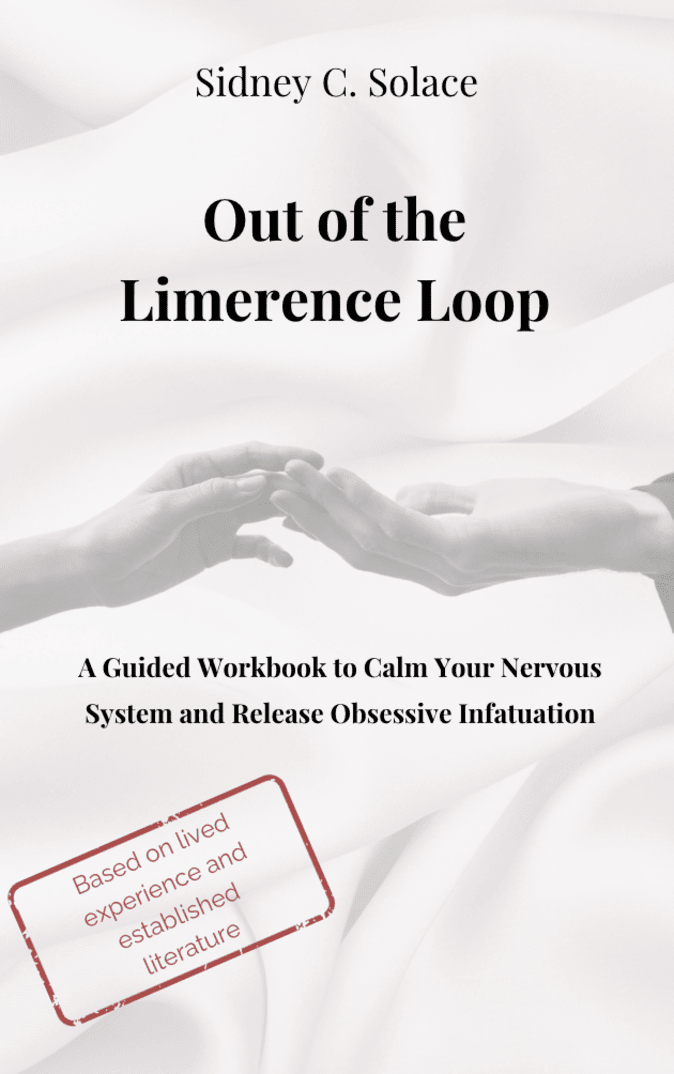
In Out of the Limerence Loop I'll go further than just explaining what limerence is. I'll also take you into the question of why this dynamic hits you so hard, specifically with this person, at this moment. In the workbook section, you'll work with pages where you will, among other things:
- map your own “recurring types” and relationship patterns
- investigates which situations and characteristics trigger you the most
- and cautiously starts to see which old needs you are projecting onto your LO
Not to invalidate your experience, but to give you more to hold onto than just hoping it will get better on its own someday.
Internal link
If you want to go back to the basics first, you can read about it here What limerence specifically is and how to recognize it in your daily life.
Frequently Asked Questions about Why Exactly Him or Her in Limerence
Did I “choose” this myself, that I'm so stuck on this person?
Unconsciously. Your brain and nervous system react to old patterns and unmet needs, often without you realizing it. It feels like it happens to you, but there are indeed patterns you can work with later.
Does limerence mean he/she is my soulmate?
No. The intensity primarily indicates how strongly your system is triggered by this person, not automatically that you are “meant for each other.” Sometimes, the most familiar pattern feels most like coming home, even if it ultimately causes you pain.
Does this have to do with trauma or my childhood?
Often, old pain and insecure or inconsistent connections increase the chance of limerence. Your LO then touches something much older than this encounter – and that's why it feels so big.
Why do I always fall for the same type of person who isn't really available?
Because your system is used to a certain dynamic (distance, unpredictability, proving yourself). Unconsciously, that feels familiar, and anything that feels familiar quickly feels like “chemistry.”.
How do I know if this is regular infatuation or limerence?
Limerence makes your head spin almost constantly around the other person, with a lot of fantasizing, anxiety, and checking (verifying, analyzing). In this article, I will explain in more detail What's the difference between regular infatuation and limerence
Does limerence go away on its own if I get enough attention from my LO?
That depends on the person. Sometimes mutual love can develop, and sometimes it doesn't, and later a new “limerence object’ comes along. Real change comes from working on your own patterns, not just from changing the situation with this one person.
About the author

Sidney C. Solace is a writer with a background in investigative journalism and years of personal experience with limerence and, more importantly, overcoming it.
She explores the psychological patterns behind obsessive infatuation and attachment, and writes for people who seem to function on the outside but feel completely consumed by one person on the inside. In Out of the Limerence Loop, she combines theory and practice to give readers more language, calm, and direction on their path to recovery.