

In this article, you'll read how limerence creates a loop in your brain, where hope, excitement, and disappointment constantly alternate as if you're stuck in an emotional slot machine.
You'll discover why small signals from your LO (the person you're limerent for) get such a huge charge, why uncertainty only strengthens the loop, and why limerence therefore seems so much like an addiction cycle without it simply being a lack of willpower.
We're looking at what psychologically happens in that limerence loop, which you often don't realize while you're in it, and what initial small steps you can take to stop being driven solely by hope and fear.
My experience with the loop
I often had my phone back in my hand before I even realized it. There was an app where it was just the two of us; so if he had looked, I would have known almost for sure it was because of me. I was in a “checking if he checked” prison that I had helped build myself, but also not really. The constant need for validation exhausted me, but at the same time, it felt like my system couldn't stop.
Just as we are often driven by ingrained habits that bring us more trouble than pleasure in our adult lives, old survival strategies can later behave like monsters. Patterns that once helped us deal with distance, unpredictability, or mixed signals then reemerge in new forms, such as an app that suddenly demands your full attention.
But if you recognize this and are reading it, you are already doing something important: you are trying to understand yourself. That is no small thing, but a huge step towards recovery.
If you notice that you can see the loop but don't know how to loosen its grip, you can also read How to Stop Limerence: Why Letting Go Is So Difficult (and What Actually Helps). If you recognize yourself in the limerence loop of hoping, magnifying small signals, and getting pulled back in, Why You Try to Understand Everything About That Other Person explores the pattern of endless analyzing and mentally piecing things together in more detail.
The limerence loop can also continue when there has been no contact for a long time: your mind clearly sees what the contact cost you, while another part of you still reaches back to hope and fantasy. In Limerence: Two Realities I will go into more detail about that dual experience.
What the limerence loop is (and what happens in your head)
The limerence loop is the recurring cycle where you feel a glimmer of hope, then check again, interpret, fantasize, or wait, subsequently receive a small “reward” or disappointment, and then again feel the urge to search for the next sign.
In your head, this happens:
- Your brain links your LO to reward (dopamine, a feeling of relief or “yes”).
- every unpredictable reaction, sometimes yes, sometimes no, sometimes warm, sometimes quiet, works like a kind of slot machine for your nervous system.
- That uncertainty can keep you checking for signs and hoping for a reward, rather than feeling settled in a calm, predictable connection.
So it's not that you're weak; your brain is responding to a pattern of intermittent reward, and that's one of the most powerful ways behavior can become entrenched.
You could summarize the loop as a system of:
- hoping
- checking
- a small sign or silence
- a lot of interpretation
- restlessness
- renewed hope
And then it starts all over again.
In What Is Limerence? you can read more about what limerence actually is. In Just in Love or Limerence?, you can learn how this loop differs from ordinary infatuation.
Do you recognize how your limerence loop overlaps with ADHD-related experiences such as hyperfocus, dopamine-seeking, and rejection sensitive dysphoria? In Limerence and ADHD, you'll find experiences you may relate to and exercises that take into account a brain that works quickly and intensely.
The combination of hope, uncertainty, and searching for small signs can fuel a limerence loop for a long time. In The First Important Book About Limerence: What Dorothy Tennov Taught Us, you can read how Tennov described this dynamic early on.
Why uncertainty is so addictive
Many people think that limerence is primarily amplified by love or chemistry, but insecurity often plays at least as big a role. Precisely when you don't know where you stand, your brain keeps scanning: what did that text message mean? Why did he look at me and say nothing? Could there still be something there?
This can make a small sign from your love interest, a glance, a like, a short comment, or someone who looked, feel much bigger than it objectively is. It's no longer just about that one action; it's about what your system hopes it means.
If your limerence mainly plays out through your phone, online signals, and repeated checking, Limerence and Your Smartphone explores these patterns in more detail. If you notice that this mechanism also plays a strong role with a celebrity or someone you don't really know, you may recognize similar patterns in Limerence for a Movie Star or Pop Star.
What you often don't realize while you're in it
When you're in the thick of the limerence loop, it usually doesn't feel like you're in a pattern. It feels like you're just trying to get clarity, or that you just need to understand what's going on.
But often something else happens: your brain gets more and more used to searching for, hoping for, and reacting to crumbs. As a result, your attention narrows, and everything in your day eventually seems to lead back to that one person.
What you also may not realize is that the loop is fueled not only by longing, but also by old pain. For some people, limerence touches on attachment wounds, abandonment, mixed signals from previous relationships, or a deeply rooted need for validation.
That's why Limerence and Attachment Styles is such an important follow-up article: it can help you understand why your system may be particularly sensitive to this dynamic.
The articles Why Him or Her? and Limerence: What You Don’t See When You’re in It can also help you better understand that underlying layer.
When the loop takes over your daily life
A limerence loop doesn't stay neatly in the background. For many people, it starts to take over their daily rhythm, energy, and mood.
You're getting tired of checking, but you can't quite stop. You rationally know something is taking up too much space, but emotionally, every signal feels like it matters.
Then you can notice things like:
- always picking up your phone without a conscious choice
- replaying fantasies or scenarios in your head
- Having trouble concentrating on work, family, or rest
- a mood that moves with mini-signals
- the feeling that you are just waiting
If limerence feels like a constant pull, craving, or restlessness, it may help to explore the similarities between limerence and addiction. If the pattern has been repeating for a long time, When Limerence Seems Chronic can be an important next step. In Two Exercises That Gently Interrupt Limerence, you'll find two practical ways to create small pauses in the limerence loop.
First small steps
You don't have to break the entire limerence loop at once. It helps more to first learn to recognize it, and then to interrupt it at small points.
- Name the loop by name.
Tell yourself: “I am in the limerence loop right now.” This pulls you slightly out of the fusion with the feeling. - Identify the most recent trigger.
Was it an app, a glance, a thought, a memory, a song? Seeing the hook makes the pattern more concrete. - Wait one minute before you check.
Not to be perfect, but to make the automatic moment a little less automatic. - Write down only the facts.
Not: “He's probably thinking about me.” Instead: “He looked.” Or: “There was no reaction.” This helps your brain return from interpretation to reality. - Choose a mini-action that brings you back to yourself.
Go for a walk, drink some water, call someone, name something you feel in your body. Small things really count here.
If you want to know what choices help you get out of this loop, then I will describe in Limerence and boundaries: why recovery goes against your tendencies how boundaries often go exactly against your automatic tendency.
As you become better at recognizing the limerence loop, you may notice that you spend less time caught up in hope, fantasy, and analysis. This article about the beginning of recovery can help you recognize those small but important shifts.
Different exercises; choose what suits you.
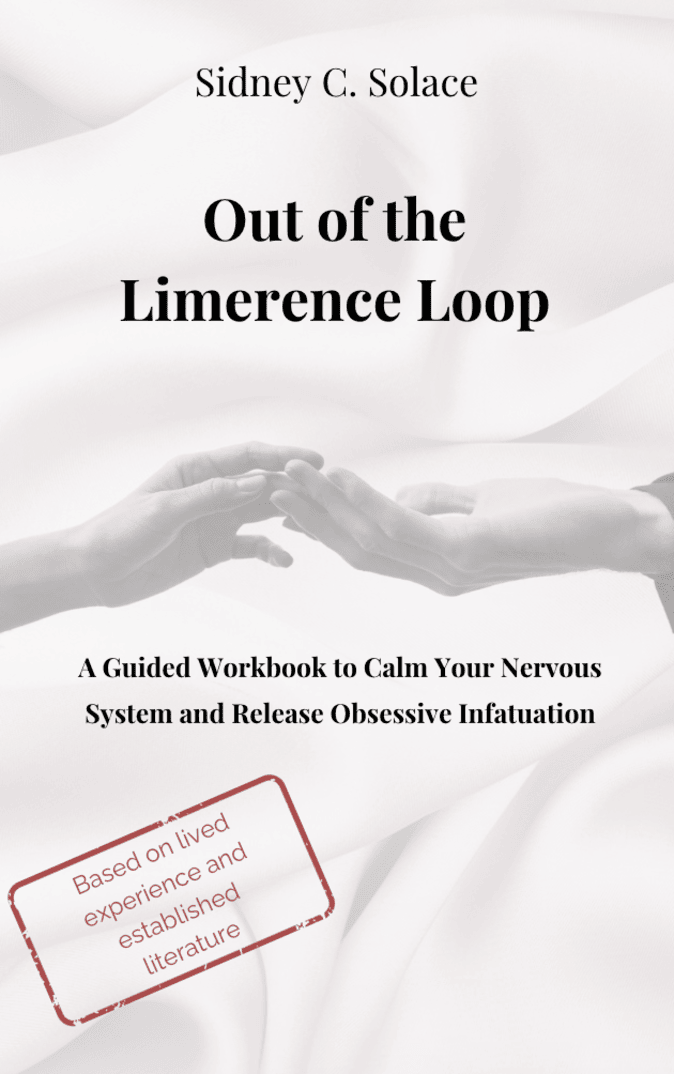
In my workbook, you'll find exercises designed for exactly these moments, helping you return to the present and ride out urges. The workbook isn't meant to be another theory book, but a practical space to gently recognize and interrupt your patterns.
You're not alone if you're stuck in a loop like this. The good news is that while limerence can feel intense, it's not mysterious or untouchable. The better you get at recognizing it, the more space will slowly emerge between the trigger and your reaction, and that's precisely where change begins.
Frequently Asked Questions About Why Stopping Limerence is Difficult.
Is the limerence loop the same as love?
No. Love can be intense, but a limerence loop often revolves much more strongly around insecurity, obsessive thoughts, hope, and validation.
Why does a small signal from my LO feel so big?
Because your brain doesn't just perceive it as information, but as potential relief, hope, or confirmation. This gives something small immense weight.
Can no contact help with a limerence loop?
Yes. For many people, distance reduces exposure to new triggers and moments of reward. You can read more about this in No Contact in Limerence.
Why do I automatically grab my phone?
Because the loop often becomes partially automated. Your brain learns: checking might provide relief, and therefore repeats that faster and faster.
Can I stop limerence?
Yes. I managed it too. Recovery usually doesn't start with one big breakthrough, but with very small moments of recognizing, pausing, and choosing something different.
About the author

I’m Sidney, a writer and the person behind Sid’s Saferoom. I draw on years of personal experience with limerence, and I’m a certified trauma-informed coach (IPHM-accredited through The Complete Approach).
Knowing firsthand how lonely and exhausting obsessive infatuation can be, I dedicate my work to helping others heal. I write about it and developed the theory and workbook Out of the Limerence Loop. My mission is to provide you with the psychological insights and practical tools needed to interrupt the obsessive loop and restore peace to your nervous system.
- Want to know more? Read my full story on the About Me page.
- Weekly support? Subscribe to my English-language essays at substack.com.