

In this article, you'll read about the forms of help available for limerence and why there isn't a single standard “treatment” that works for everyone. Limerence affects multiple layers simultaneously: your brain, your nervous system, your attachment, your history, and your current relationships. You'll discover when psychotherapy might be a good fit, when a pragmatic approach with exercises helps, how these two can coexist, and where my own working method fits in.
There isn't one treatment for limerence
Limerence is more than just being very in love. In What is Limerence I explain that it's about a pattern where your mind becomes almost entirely focused on one person: obsessive thoughts, hope, fantasy, checking, big highs on small signals, and deep lows in silence.
In Limerence is similar to addiction describe that limerence behaves like a kind of emotional addiction: a combination of dopamine, uncertainty, and small rewards that keeps drawing your system back into the same loop.
Furthermore, limerence is often connected to attachment and old patterns. In Limerence and attachment styles Can you read how, for example, abandonment issues, commitment issues, or mixed signals from past relationships come together in why you're stuck with this particular person?. In Limerence and anxious attachment I describe how, in addition to symptom-focused tips, you can also start building more inner safety so that limerence loses its grip.
Because limerence has so many layers, there's no single “official protocol” that works for everyone. Different people need different things at different times: insight into their history, practical exercises in the here and now, psychotherapy, coaching, or a combination thereof.
When psychotherapy is a good fit
For some people, it's very important to understand first why end up in this pattern. Perhaps you recognize that you:
- want to know exactly what your attachment style looks like;
- Does it feel like old pain or trauma is playing a role in how you approach relationships now?;
- keeps falling into similar dynamics, even outside of limerence.
In those cases, psychotherapy or trauma-focused therapy can be very helpful. With a psychologist or therapist, you can:
- creating a safe space for your history: family of origin, past relationships, loss, experiences of rejection or overwhelm;
- Investigating attachment styles: how do you react to closeness, distance, mixed signals;
- learn to recognize which triggers from the past are repeating themselves in your current limerence situation.
That doesn't mean therapy has to be “endlessly picking apart the past.” Good therapy links the past and the present: why does this situation feel so intense, and what old pain is it touching? For some people, that's the foundation they need to even begin to imagine wanting things differently.
10 Valuable Insights in a Free Guide
Some people who land on this page have googled limerence tens of times. You know the definition. You know the stages. But there's a big difference between knowing what it is and actually getting out of it. I wrote a free guide with 10 insights that go a bit deeper. A guide that can help you on your way and explain that you are not alone.
When a pragmatic, practice-oriented approach helps
Others feel the opposite: “I understand there's a lot going on underneath, but right now I mainly want to know what I can do differently today.” Perhaps you recognize that:
- stuck in a fantasy and rumination spiral around your LO;
- You're constantly checking your phone, re-reading conversations, playing out scenarios;
- having difficulty staying in the here and now with work, studies, friends, body;
- need concrete steps instead of just talking.
In that case, a pragmatic approach with plenty of exercises would also be suitable. Think of:
- no-contact experiments and digital boundaries;
- Exercises to bring your attention back to your body;
- Small steps to organize your day less around your LO;
- writing, reflecting, clear check-ins with yourself.
That is also my own focal point. In my workbook and in the way I work with people, the emphasis is on executing exercises in the present:
- Get your brain out of the fantasy spiral;
- allow your nervous system to land in the here and now more often;
- Step-by-step practice with boundaries and other choices.;
- to feel your own life palpably in the foreground again.
That does not mean we can never talk about your underlying patterns. But for some people, a combination of different therapies works very well.
If you are in doubt as to whether you are still entitled to help or grief because your limerence was “just an unattainable crush,” then you will find in Limerence and deep shame words for that self-reproach and ideas for small steps toward more self-respect.
Recovery from limerence rarely proceeds in a straight line: even after a long time without contact, old thoughts and desires can temporarily resurface. In Limerence: Two Realities read what can then happen in your brain and nervous system.
Exercises and psychotherapy: side-by-side, not either-or
A misconception is that you should choose between “therapy only” or “exercises only.” In practice, these two often work well together. next to each other.
Examples:
- You have a therapist who is working with you on attachment, childhood, and trauma, and you are using my workbook and blogs as a practical scaffold to break the limerence loop at home.
- You practice body-oriented therapy or trauma therapy, and in addition, you practice making small daily choices: not checking, writing instead, focusing on your breath and feet for a minute.
- You start with a period of a lot of exercises and structure to calm your mind, and later feel space to have deeper conversations about your history.
In Limerence and shame I'll discuss how shame sometimes prevents you from seeking help in the first place. It's important to know that you don't have to be “shame-free and stable” before you're allowed to ask for guidance. Exercises, conversations, therapy – they can complement each other, and you get to choose what is bearable and achievable right now.
How my theory book, workbook, and way of working fit into this
My theory book “Getting over Limerence” is made as psychoeducation: explanation and language for what happens in your head, nervous system, and attachment layer. You will read, among other things:
- why limerence feels so much like an addictive loop;
- how old patterns (not being chosen, mixed signals, unavailable love) can repeat themselves;
- why recovery often feels unattractive and boring at first;
- and why interrupting is different from suppressing.
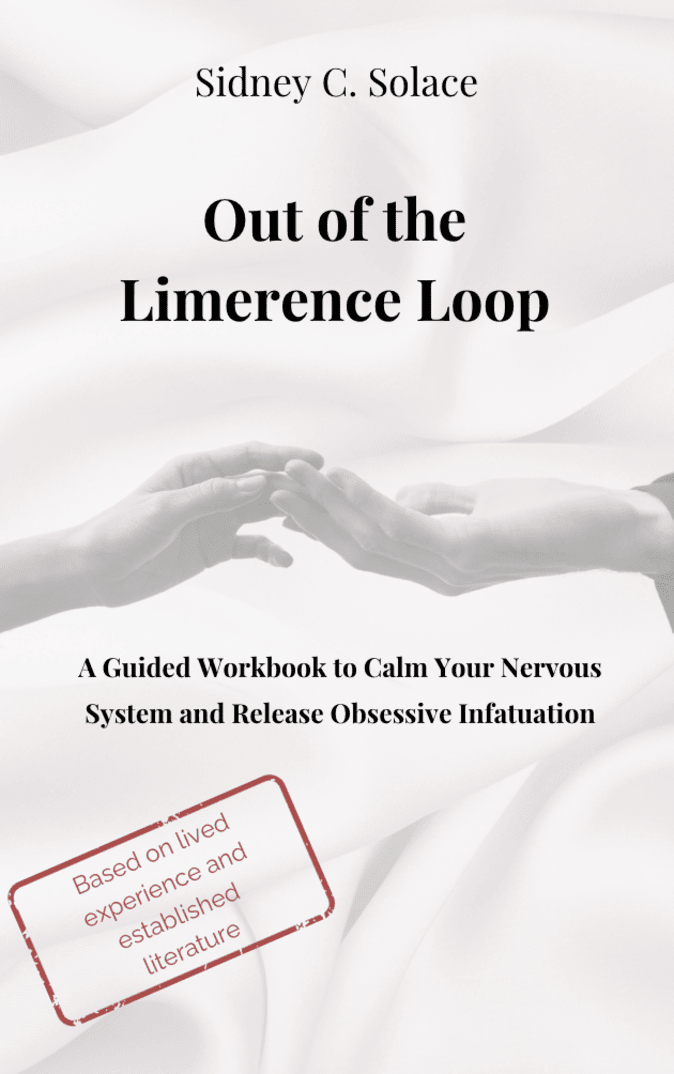
theory book comes with a workbook with many concrete exercises, check-ins, and reflections. The workbook is specifically designed for people who:
- not only want to “understand”, but also want to do;
- step-by-step make their limerence loop visible;
- Want to practice no-contact, boundaries, digital friction, body exercises;
- want to slowly shift their energy towards things where they are the main character.
In my own way of working with people, the focus is therefore on the Here and nowby practicing exercises in daily life so that your brain learns new pathways instead of the old fantasy loop. At the same time, this doesn't mean underlying patterns shouldn't have a place. We can explore in conversations how events, losses, or patterns from your youth have contributed to your limerence – but I will always look at how we can connect that to what you can do differently today.
How to choose what suits you
You don't have to know right away which form of help is “the right” one. A few questions can help:
- Do I mainly need understanding, words, and recognition for my story right now?
- Or do I notice that I urgently need something to get me out of my fantasies and peak cycle?
- Does it feel feasible to talk to someone about my childhood and attachment, or do I want to take small, concrete steps in my daily life first?
You can start with one entry point and adjust later. Some people start with therapy and then add a workbook for structure; others start with exercises and later feel there's room to talk more deeply. Neither route is better or worse – it's about what fits your brain, body, and capacity.
If you feel that my working method, which is practice-oriented, here-and-now, with room for patterns but not exclusively so, might suit you, feel free to email me. In an initial, brief meeting, we'll look together:
- where you are currently most stuck;
- or if a path feels right for me;
- and how we can map out a path that aligns with your life in terms of shape, pace, and investment.
The introductory meeting is intended as a starting point for collaboration, not as a free “venting session.” It's a calm way to gauge whether you want to continue working with me and if I am the right person to guide you through limerence. Anyone can have ideas about what's best, but you decide where you stand.
Just this one more thing
You are not weak or “overdramatic” for needing help with limerence. This pattern is intense, confusing, and often ingrained over years. It makes sense that you can't get out of it on your own.
Treatment doesn't mean there's “something wrong” with you; it means you're willing to look together at what you need. This can be through insight, through exercises, through therapy, or through a combination – and you get to choose and change within that.
Small steps, a lot of gentleness, and slowly making space again for your own life: that's what limerence treatment is all about.
Frequently Asked Questions about Limerence and Treatment
Is there an official treatment for limerence?
No. Limerence does not (yet) have a single fixed treatment protocol. However, there are paths through psychoeducation, workbooks/exercises, coaching, and psychotherapy, which can be combined.
Do I always have to go to a psychologist if I have limerence?
Not necessarily. If old pain, trauma, anxiety, or depression plays a significant role in your daily life, therapy is often helpful. If you primarily want practical help to fantasize less today, an explanation of what's happening in your head and some exercises can also do a lot. It can also be daunting to take the step towards professional help; do what feels right for you.
Can I make progress with exercises alone?
Yes, many people are already noticing a difference from here-and-now exercises and boundaries: checking in less, experiencing their bodies more, and engaging more in daily life. For some, that's enough; for others, it's a stepping stone to further therapy.
Can I do therapy and a workbook at the same time?
Everything can be done at the same time, however you prefer.
How do I know if working with you is a good fit for me?
Read a few blog posts, get a feel for my tone, and ask yourself if a practice-oriented, here-and-now approach suits you. If so, you can email me for an initial conversation where we'll explore together whether a coaching program is meaningful.
About the author

I am Sidney, writer, researcher, and the driving force behind Sid's Saferoom. In addition to my years of personal experience with breaking free from limerence, I am certified Trauma-Informed Coach (IPHM-accredited via Kirsty Watson, The Complete Approach).
Knowing firsthand how lonely and exhausting obsessive infatuation can be, I dedicate my work to helping others heal. I write about it and developed the theory and workbook Out of the Limerence Loop. My mission is to provide you with the psychological insights and practical tools needed to interrupt the obsessive loop and restore peace to your nervous system.
- Want to know more? Read my full story on the About me-page.
- Weekly support? Subscribe to my English-language essays at substack.com.