

In this article, you'll read why limerence often feels “addictive” and how that's truly linked to your brain, dopamine, and the reward system. You'll discover which patterns limerence shares with addiction (like highs and lows, tolerance, cravings, and relapse) and how you can use that knowledge to gradually approach this dynamic differently.
I'm also writing about this from personal experience. During periods of limerence, I noticed I constantly wanted to check my phone, that a message or glance from my limerent object felt like a high, and that my life seemed almost boring and faded if that other person wasn't a part of my future plans or if there was no contact. These are precisely the phenomena that much addiction research also describes: your brain becomes dependent on a specific source of dopamine, and everything outside of that feels less vivid. From that experience, and from knowledge gained from trauma and addiction literature, I have collected all the exercises in my workbook that helped me recognize these patterns and gradually lessen their grip.
If your limerence is primarily focused on a celebrity, you might recognize how posters, concerts, and social media become part of that addiction loop; you can read more about that in Limerence for a movie star or pop star.
If you want to understand why your specific history and attachment style make all of this so intense, it helps Limerence and attachment styles to establish the link between past pain and this current obsession.
Limerence in the Brain: Dopamine and Reward
Limerence is not an official diagnosis, but it is a psychologically described state of obsessive infatuation and romantic obsession. Neuroscientists and clinicians describe limerence as utilizing the same dopaminergic reward pathways as addiction: when you receive a positive signal from your limerent object, such as a message, a glance, a like, or an spontaneous moment of contact, your brain releases a dopamine surge in the reward system.
The dopamine system (including the ventral tegmental area and nucleus accumbens, among others) is the same system that is activated by substances like cocaine, by gambling, and by smartphone use that provides constant small reward stimuli. The result:
- You feel euphoric or relieved upon contact or hope.
- Your brain wants to repeat that feeling and will actively search for new stimuli from the same source.
- The rest of your life feels less attractive because those other things don't give the same dopamine hit.
In my blog What is limerence? I'll explain the basics of this condition; here we'll primarily focus on why it can seem so much like an addiction. Many people feel ashamed that their infatuation feels so addiction-like. In Limerence and shame I'll go into detail about how that works and why it says nothing about your value as a human being.
Person addiction: addicted to a person
In addiction literature, alongside substance addiction, the term “person addiction” is also used: an addiction-like dependence on one person as the primary source of dopamine and emotional regulation. With limerence, many of the same elements are seen:
- The other person becomes your primary source of tension, hope, and relief.
- Your thoughts revolve around the question of whether or not you'll be chosen.
- A message or small approach gives a high, silence or distance feels like withdrawal.
Researchers describe how exactly uncertainty en intermittent reinforcement (an occasional positive response, unpredictable) to activate the reward system even more strongly: your brain responds more strongly to a varying pattern than to a stable, predictable reward.npr+2
That explains why limerence often intensifies in people who are not clearly available: the “maybe” triggers an addiction-like search for confirmation. In my blog Just in love or limerence? I will delve into the difference between this restless person-addiction dynamic and calmer, reciprocal love.
If you feel your limerence is more like an addiction than being in love, it can Limerence Treatment: What Help Is Right for You? to help you investigate which form of support would be most suitable.
10 Valuable Insights in a Free Guide
Some people who land on this page have googled limerence tens of times. You know the definition. You know the stages. But there's a big difference between knowing what it is and actually getting out of it. I wrote a free guide with 10 insights that go a bit deeper. A guide that can help you on your way and explain that you are not alone.
Highs, lows, and your smartphone
Addiction almost always goes hand in hand with a cycle of highs and lows. With limerence, you see that reflected in:
- Euphoria upon contact, signs of interest, or fantasies where your future together feels bright.
- Deep dips when distant, silent, rejected, or ambiguous.
- A strong craving to curb those dips with new stimuli: checking, texting, searching.
Smartphones amplify this cycle. Studies show that every notification, every check can provide small doses of dopamine; over time, your brain begins to anticipate dopamine even before a notification arrives, causing you to compulsively check your phone.
In limerence, your smartphone is your direct line to the object of your limerence:
- You're checking more than necessary.
- You scroll through old conversations as if they are little dopamine hits.
- At every moment, you hope for a new sign that you're special.
In my own process, it genuinely felt like an addiction: the restlessness, the constant reaching for my phone, the feeling that everything became dull and faded without contact. That realization, “this doesn't just resemble addiction, my brain also behaves this way,” was a turning point for me to look at my behavior differently.
If you find that intrusive thoughts and checking behaviors are taking over your life, it might help to check out my blog as well Intrusive thoughts in limerence to read, where I explain how such thoughts work and which steps help to create some space in your head again.
Tolerance and Withdrawal: Why It Keeps Getting More Intense
Another characteristic of addiction that reappears in limerence is toleranceOver time, you need more or more intense stimuli to feel the same high. Where a smile was once enough, later you want longer conversations, deeper confessions, more intimacy. phuketislandrehab+1
And at withdrawal Do you notice that your body and emotions really revolt when the stimulus is removed:
- restlessness, insomnia, heart palpitations;
- gloom or emptiness;
- preoccupation with “what if” scenarios and fantasies.
The processes make it extra difficult to set boundaries, as distancing yourself is not only a rational choice but also feels like withdrawal. In my blog Limerence and boundaries: when it hurts your life I'll take a closer look at how limerence specifically affects your work, relationships, and health, and why boundaries are so complicated but often necessary.
If, in addition to shame about your feelings, you also feel shame about your behavior or the situation you have ended up in, then Limerence and deep shame help to better understand that moral tension.
Is limerence just addiction?
Many authors emphasize that limerence has both addictive characteristics and is connected to attachment, trauma, and the human desire for connection. Therefore, it is too simplistic to say “it's just addiction”; it is a mix of:
- neurobiology (dopamine and reward systems),
- psychological patterns (attachment, insecurity, self-image),
- and life stories (experiences of not being chosen, not being seen, or being abandoned).
This combination is precisely why it's important to be kind to yourself: you didn't choose this dynamic, but you can learn to handle it differently. In my blog when limerence seems chronic Let me show you what recurring patterns can look like and why they are not proof that you are “broken,” but an invitation to look at yourself and your relationships differently.
First steps to move out of the addiction cycle
In this blog, you've read how limerence uses the same reward system as addiction: dopamine highs on contact, lows on distance, a smartphone that feels like a slot machine, and a brain that repeatedly chooses the same route to moments of excitement and hope. These aren't patterns you solve with one good tip; they require repetition, structure, and exercises that help your nervous system forge new pathways.
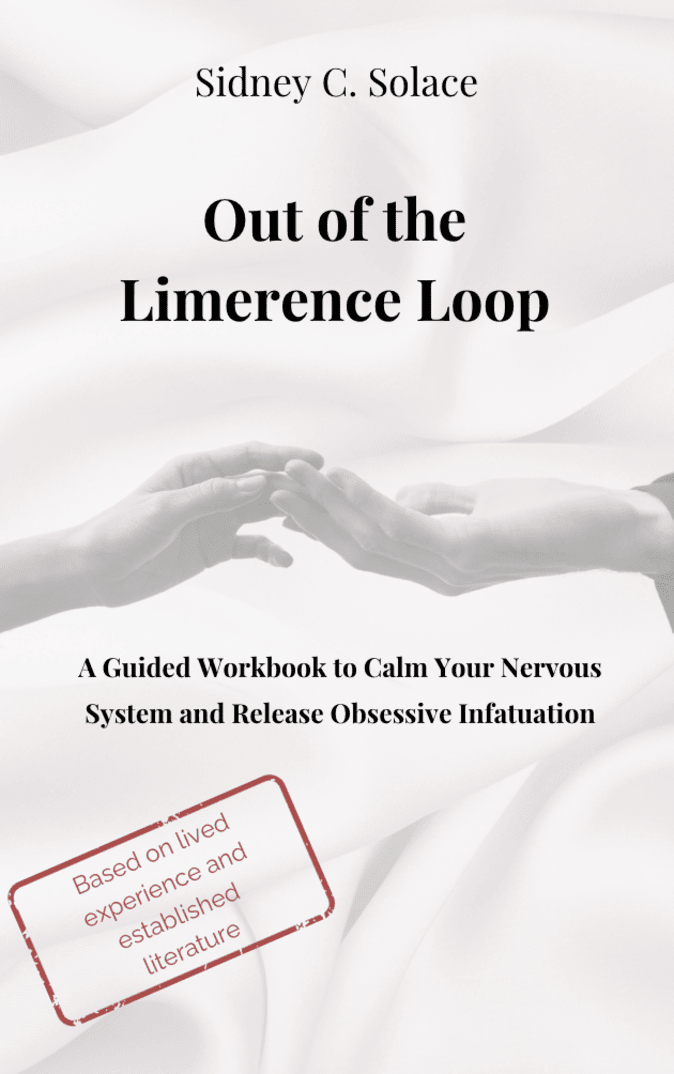
That's exactly what I made my workbook for. The exercises in Out of the Limerence Loop. are very intentionally designed to intervene in this “addiction cycle” on different levels: some work through the body (senses, anchor phrases, returning to the present), others through language and reflection (seeing how often you slip, which triggers evoke your highs and lows), and still others through small, repeatable steps that structure your day.
In the workbook:
- learn to concretely name what is happening now, so that your brain doesn't just get stuck in fantasy and scenarios but reconnects with the here and now;
- Map out your own triggers, dopamine rushes, and relapse patterns instead of just “knowing” in your head that you have addiction symptoms.
- Practice with anchor sentences and small daily choices to bring your attention back to your life, step by step, instead of solely to your limerent object.
My book consists of two parts. In the first part, I explain in simple terms what limerence is, the patterns underlying it, and how it differs from ordinary infatuation. Just knowing what you're dealing with can make many people feel they're not crazy and that they're not alone in their experiences. However, simply knowing the theory is usually not enough to get out of limerence. Insight helps you to understand yourself better, while the exercises in the workbook help you to translate that insight into different behavior step by step, leading to more presence in your own life and more peace in your mind and body.
Not every exercise will suit everyone; that's precisely why you can calmly try out which form helps your brain to get unstuck from those familiar addiction pathways. In my book, I work on two levels: cognitive (insight and words, so you understand what's happening and why) and physical (exercises through your body and senses, so your nervous system doesn't have to remain in the limerence-stress mode).
FAQ: Limerence and Addiction
Is limerence a real addiction?
Limerence is not an official addiction diagnosis, but it does activate the same dopaminergic reward pathways as substance and behavioral addictions and can exhibit the same patterns of highs, lows, cravings, and relapse.
Why does my phone feel so addictive in limerence?
Because any possible contact with your limerent object, notification, message, or social media signal can provide dopamine, and smartphone research shows that even checking it can trigger small dopamine shots. Together, this makes your phone a kind of slot machine for your brain.
Does this mean I have a “weak character”?
No. Addictive patterns stem from a combination of neurobiology, learning experiences, attachment, and coping, not from “weakness” or “ill will.” It does require responsibility to recognize what it is doing and to work with it step by step.
Does treating limerence purely as an addiction (like going cold turkey) help?
For some, sharp no contact works as part of recovery, but because limerence also has to do with attachment and trauma, just “cold turkey” is often not enough; it also requires emotional processing and building other sources of safety and reward.
How can your workbook help with this addiction side?
In my workbook, I use insights from addiction and trauma research to help you recognize your own dopamine loops, triggers, and highs/lows, and I offer exercises to practice making different choices step by step: checking less, finding other sources of reward, and being more present in your own life. It's a practical way to translate the science of limerence and addiction into achievable daily steps; not to punish yourself, but to get your brain working more in service of you again.
About the author

I am Sidney, writer, researcher, and the driving force behind Sid's Saferoom. In addition to my years of personal experience with breaking free from limerence, I am certified Trauma-Informed Coach (IPHM-accredited via Kirsty Watson, The Complete Approach).
Knowing firsthand how lonely and exhausting obsessive infatuation can be, I dedicate my work to helping others heal. I write about it and developed the theory and workbook Out of the Limerence Loop. My mission is to provide you with the psychological insights and practical tools needed to interrupt the obsessive loop and restore peace to your nervous system.
- Want to know more? Read my full story on the About me-page.
- Weekly support? Subscribe to my English-language essays at substack.com.