

In this article, you'll read about what love can look like after limerence, what realistic recovery entails, and which small steps will help you avoid getting stuck in obsessive patterns forever.
When you're in the midst of limerence, it often feels like your love life is “broken” forever. As if you'll either always love obsessively or never truly feel anything again. Many people wonder: Will there ever be a relationship that isn't so intense, but is real?
The short answer: yes, it's possible – but it will likely look different than you're used to now. Did you end up here without knowing exactly what limerence is? In this article I'll explain What limerence specifically is and how to recognize it in your daily life.
And if, after a breakup or taking time apart, you notice your thoughts still keep circling, then also read Limerence and closure: when your mind won’t let go after the contact ends.
What we often expect from love after limerence
With limerence, you usually long for two things at once: security and fire. You never want to be shattered by obsession again, but you're also afraid of “boring” relationships. Your system often still equates intensity with love: a lot of tension, a lot of drama, a lot of worrying.
Healthy love sometimes feels almost too calm at first in comparison. Less worrying, less high, less panic when you don't hear from them for a while – and precisely because of that, it can seem awkward, flat, or even “boring.” That's not a sign that you don't feel anything, but that your nervous system is still used to adrenaline instead of regulation.
If you're in the middle of recovery and still find your thoughts returning to someone outside your relationship, it can in love with someone other than your partner help you better understand and contextualize the tension between your existing relationship and limerence.
Even if the relationship is truly over, your mind can go on with imaginary conversations for a long time. In Why you keep having conversations in your head with your ex Read how that works and how space can still be created for a life after limerence.
Recovery is not a “fix” but a shift.
There is no magic exercise that will make you never experience limerence again. Recovery is more like a shift:
- Searching for everything outside yourself, to increasingly be able to remain with yourself
- From fantasy and idealization, to being curious about the real other
- From chasing stimuli to realizing that rest is also valuable
That's not a straight line. You can be very stable for a while and then suddenly be triggered again by a new person or an old limerent object. The difference is: you recognize what's happening faster and you have more tools to catch yourself. If you want to understand how you got into limerence in the first place and why it could last so long, then... How does limerence develop and how long does it last? there more background and first steps to it.
10 Valuable Insights in a Free Guide
Some people who land on this page have googled limerence tens of times. You know the definition. You know the stages. But there's a big difference between knowing what it is and actually getting out of it. I wrote a free guide with 10 insights that go a bit deeper. A guide that can help you on your way and explain that you are not alone.
Three movements that almost everyone encounters in recovery
These are not “1-2-3 and done” step-by-step plans, but movements that recur in many recovery stories.
- From LO-focus to self-focus
You learn to not constantly redirect your attention to “what is he/she thinking or feeling?”, but to gently bring it back to “what is happening within me right now?”. That sounds simple, but it's intense work – especially if your brain has used "other-oriented thinking" as a survival strategy for years. - From all-or-nothing to nuance
In limerence, things are often black and white: perfect or disaster, soulmate or no one, all or nothing. In recovery, more room emerges for “okay,” “good enough,” “not yet sure.” This makes relationships less dramatic, but also more real. - From control to contact
Instead of trying to control the other person (or yourself) – texts, timing, distance, closeness – shift towards genuine connection: being able to say what's happening within you, setting boundaries, asking for something instead of guessing. That feels vulnerable, but it's also where healthy intimacy begins.
Do you find yourself dwelling on the question of why it has to be this particular person, despite everything? In this article, I will delve deeper into why exactly he or she can be such a strong trigger for your limerence.
If you feel that limerence continues to be a recurring pattern in your life, “How to stop limerence ” can help you see, in concrete terms, that stopping is a gradual process, in which various exercises and changes can all work together to help.
Many people only move forward when they dare to seek help. Limerence Treatment: What Help Is Right for You? I describe different routes and how you can see what suits you.
How do you know you're healing?
There is no yardstick, but there are signs that many people recognize as signs of recovery:
- You can have longer moments when you are not thinking about your LO.
- You notice triggers (“oh, I'm going into idealization again”) instead of automatically going along with them.
- You can comfort or regulate yourself without immediately seeking contact or stalking.
- My interest is slowly shifting from “how do I get him/her?” to “how do I want to feel in relationships?”
And perhaps most importantly: you start to believe that your love story isn't tied to that one person. That there are multiple paths to connection, and that you have an active role in it.
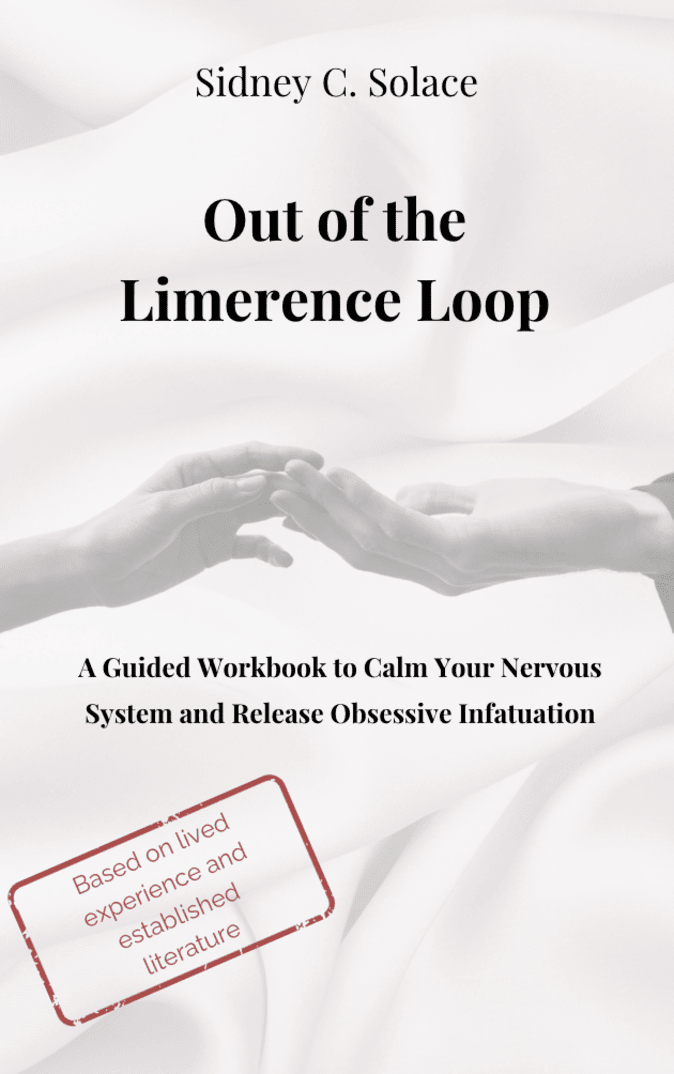
Do you think you still need help, and are you finding that your limerence complaints continue to plague you in your daily life? I have written a book, Out of the Limerence Loop., in which I explain the theory surrounding limerence as well as share practical exercises that have helped me step by step to break free from this dynamic in my daily life. I myself experienced periods of limerence from my teenage years well into my forties, and this book originated precisely from that experience.
What if you're afraid you'll never feel good again?
The fear is very normal. Limerence often feels like the most intense thing you've ever experienced. The thought that you'll never feel that way again can bring on grief – for the LO, but also for a version of yourself that could become so engrossed in someone.
It helps to put two things side by side:
- Yes, the highlights were really intense.
- And yes, the price you paid for it – in fear, control, dependence – was also real.
Recovery doesn't mean you'll never get hurt or love deeply again. It means you're no longer willing to lose yourself completely to feel that intensity. Are you still in the phase where keeping your distance or having less contact feels almost impossible? In this article, you can read more about No contact with limerence and why distance is so difficult.
When you're ready to see what boundaries will help you move step by step towards a life without limerence, you can Limerence and boundaries: why recovery goes against your tendencies be a next step.
Love after limerence: what can that look like?
Healthy love after limerence is often less cinematic, but much more reliable:
- Someone who is consistent, even when you're wavering.
- There is space for your inner world, without the other person needing to “save” you.
- Conflicts that don't immediately feel like the end of the world.
- Attraction that isn't based on drama, mystery, or unattainability.
It might take a while for your system to recognize that as attractive. Sometimes only after you've first invested time primarily in therapy, self-exploration, or time alone.
If you want to recognize things you might not have seen while you were in the midst of limerence, such as how much you gave, how often you drifted away in thought or on your smartphone, and what that did to your surroundings, then it offers limerence: what you often don't realize while you're in it an honest and recognizable mirror.
Frequently Asked Questions about Love and Life After Limerence
Does limerence ever fully go away? Can limerence stop?
For many people, limerence becomes less intense and less all-consuming over time, especially when you work on your patterns and triggers. It's not so much “gone,” but it has less power over your choices and self-image. You can truly overcome it.
Can I have a healthy relationship after limerence?
Yes. Many people find that after this phase, they start to make more conscious choices, feel their boundaries better, and dare to be more honest about their needs. Healthy love often feels calmer and safer than you are used to with limerence, but no less real.
How do I know if I'm recovering from limerence?
Signs include: less obsessive thinking about your *lover*, better sleep, less urge to force contact, and more interest in your own life. You'll also often notice: “I feel bad, but I can handle this,” without immediately needing the other person as an escape route.
What if I'm afraid I'll never feel good again?
Unfortunately, anxiety fits very well with limerence because your mood becomes so tied to one person and one story. Precisely by building your own regulation, sources of support, and meaning outside of that relationship step by step, trust slowly re-emerges that you are more than this phase.
About the author

I am Sidney, writer, researcher, and the driving force behind Sid's Saferoom. In addition to my years of personal experience with breaking free from limerence, I am certified Trauma-Informed Coach (IPHM-accredited via Kirsty Watson, The Complete Approach).
Knowing firsthand how lonely and exhausting obsessive infatuation can be, I dedicate my work to helping others heal. I write about it and developed the theory and workbook Out of the Limerence Loop. My mission is to provide you with the psychological insights and practical tools needed to interrupt the obsessive loop and restore peace to your nervous system.
- Want to know more? Read my full story on the About me-page.
- Weekly support? Subscribe to my English-language essays at substack.com.