

In this article, you will read about what limerence can look like in a friendship: when thinking about a friend is no longer casual, but becomes obsessive, filled with hope, and exhausting.
This is important if you notice that your feelings toward a friend are no longer relaxed but are starting to dictate your day and your self-image.
You’ll find an explanation, familiar experiences, and a few small exercises. If you want to explore this more deeply, I’ll also tell you how my theory book and workbook can help.
I've personally experienced several limerence episodes, sometimes with someone I was “just” friends with.
For me, that meant lying awake at night, letting my mood depend on a single text message, and relationships that were overshadowed by that one person. Precisely because I know how confusing and exhausting that is, I write about limerence and created my theory book and workbook – so you don't have to figure out on your own how to create space for yourself again.
At its core, limerence involves a combination of obsessive infatuation, brain chemistry, attachment, and behavior. In my pillar article, What Is Limerence?, I explain these aspects step by step and point you to my other articles. In this article, I focus on what happens when this dynamic develops within an existing friendship.
10 Valuable Insights in a Free Guide
You may have searched for information about limerence many times already. You know the definition, and you recognise the patterns. But understanding limerence and finding your way out of the loop can feel like two very different things. I wrote a free guide with 10 insights that go a little deeper, to help you make sense of your experience, take a first step, and feel less alone.
When friendship suddenly feels like obsessive infatuation
Limerence doesn't only have to occur in romantic relationships or crushes on strangers; it can also develop in a friendship with someone you've known for a long time.
You may begin to interpret ordinary moments of friendship as signs that something romantic could develop.
Perhaps you recognize things like:
- You are “officially” friends, but you think about that person all day long.
- Every phone notification, joke, invitation, or unanswered message feels significant, and your mood rises or falls accordingly.
- You fantasize about being together, while in the outside world you function simply as friends (or while the other person is in a relationship).
- You feel shame: “If I tell them how I feel, I’ll ruin everything,” but staying silent also feels unbearable.
The elements that make friendship so enjoyable – shared memories, inside jokes, easygoing contact – often become the fuel for obsession in limerence.
There’s plenty of contact, but little clarity: the friendship feels special, yet you don’t know what it means to the other person.
Mixed signals and uncertainty can keep your hopes alive: you experience moments of warmth without knowing whether the other person wants anything romantic.
In my blog about Intrusive thoughts in limerence I'll describe how your brain keeps repeating the same conversations and moments over and over again to extract “meaning” from them.
Why limerence in friendships is so confusing
A friendship usually has a clear, platonic start: you meet up as friends, share things, and support each other.
Limerence sometimes “builds on top of” that, for example after a period of intense contact, vulnerable conversations, or a phase in which this friend became very important.
What makes it so confusing is that:
- You already have a form of closeness – laughing together, understanding each other, seeing each other.
- Part of you longs for more: mutual romantic feelings, a sense of being chosen, and perhaps an exclusive relationship.
- The other person may not know about that extra layer, or may not feel it in the same way.
This can lead you to read between the lines: “That hug lasted a little longer—it must mean something.” You might compare yourself with their other friends—“He texts me more often, so I must be special”—and spend hours worrying about what you should or shouldn’t say. In Why This Person?, I explore why one particular person can become so important to you and how uncertainty can keep you focused on them.
Recognising this pattern can be a relief: it helps you understand what is happening without labelling yourself as “crazy.”
Shame: “Am I even allowed to feel this way about a friend?”
Limerence towards a friend often involves a lot of shame: it feels like you're doing something “wrong,” even if you're just thinking and fantasizing.
The shame can become so loud that you can barely see clearly what's actually happening.
Typical thoughts include:
- “If I say this, I'm a bad person to my partner.”
- “I'll ruin the friendship if I'm honest.”
- “A good friend shouldn't be so obsessive.”
Shame can distort the way you see yourself. You may think only, “I’m weird” or “There’s something wrong with me,” even though your feelings may involve an understandable mix of needs, past hurt, and the way your brain responds to attachment and longing.
In Limerence and Shame, I describe how shame can keep you stuck in the pattern by making it harder to recognize that your needs matter too.
I myself thought for a long time that I was just unlucky: that I “just” fell in love for a long time and had a hard time letting go of people.
I didn't know then that I was suffering from limerence, that my brain mostly got stuck on people whose love wasn't truly reciprocated or who were practically unattainable.
Of course, this also plays into friendships: you often feel on some level that the person doesn't feel the same way about you, but your system still hopes for more.
If you’d like to read more, I’ve written an article about why limerence is so common with unrequited or unattainable love.
In it, I explore how a mix of closeness and uncertainty can keep the limerence loop going, and why this may feel familiar when you look back on your own experiences.
Your feelings are not a crime; they say something about your need to be seen, chosen, and safe.
You can’t always choose what you feel, but you can choose how to respond. That might mean setting boundaries, taking some distance, or thinking carefully about what you want to share with your friend.
You can be gentle with yourself while exploring what is wise and loving toward your friend as well.
If you notice that shame is completely blocking you, a first step can be simply to acknowledge: “this is a pattern many people have, I'm not the only one.”.
Can friendship and limerence coexist?
The honest answer is: sometimes yes, sometimes no, and that can shift over time.
As long as limerence is still very active – your thoughts, hopes, and mood revolve almost entirely around this friend – a “regular” friendship is usually difficult.
You notice that, for example, by:
- You are not neutral; small things feel big and decisive.
- You get hurt more easily if the other person also has other friends or a partner.
- You expect something (consciously or unconsciously) that the other person may not be able or willing to give.
For some people, friendship becomes possible again once the intensity of limerence has eased, their emotional well-being no longer depends entirely on this person, and there is room for other relationships and projects. In my article Life After Limerence, I explore what life can look like when it no longer revolves around one person and begins to feel fuller and more like your own again.
Sometimes temporary or structured distance is needed—less one-on-one time, fewer messages, and fewer vulnerable late-night conversations—to give the limerence loop less fuel and create some breathing room for yourself. I explore this further in No Contact During Limerence: distance does not always have to be permanent or drastic. It can also mean setting gentler boundaries and protecting your own nervous system.
Distance doesn't have to mean someone disappears from your life forever; it can also mean consciously choosing a form of contact that is both honest towards the other person and less harmful to you.
It also helps to look not only at what you lose, but also at what you gain in peace, space, and personal projects.
Some small exercises if you have limerence in a friendship
You don't have to decide all at once whether to keep the friendship or not; you can start with small, achievable steps that make the limerence loop less powerful.
Recovery usually doesn't begin with one big decision, but with concrete, daily interruptions in your behavior and attention.
1. Give your feelings a safe place outside of the friendship.
Write down your thoughts and fantasies in a journal so they don't just keep circling in your head.
Consider talking to a therapist, coach, or trusted friend so that this friendship isn’t your only place to express what you’re feeling.
This can help prevent you from bringing all of your difficult feelings into the friendship itself, where they might create more tension or confusion.
2. Add friction to your contact behavior
- Fewer spontaneous messages.
- Choose specific times to reply, and try not to check your phone constantly in between.
- Turn off notifications so you don't get a jolt of adrenaline with every alert.
These small pauses can interrupt the automatic cycle of “notification → hope → checking → more preoccupation.”
In my blog How to stop limerence I'll explain how this differs from "hard suppression": you focus on interrupting and tapering off, not on prohibiting yourself from feeling something.
3. Honestly examine what the friendship does for you now
Ask yourself gently
- How much space will this friendship take up in my mind and my day?
- Am I treating this friendship as though it were a romantic relationship, while the other person sees it as platonic?
- What would happen if I took some distance for a while – what would my life gain or lose then?
This reflection is not about punishing yourself, but about honestly looking at what the situation gives you and what it costs you.
If you want to understand why this particular friendship has become so important, you can also read my blog How Does Limerence Develop and How Long Does It Last?. It can help you see your current situation as part of a broader pattern.
4. Actively pay attention to other connections and projects
Limerence in a friendship can draw so much of your attention toward one person that you have less energy for other relationships.
Small steps towards other relationships and your own projects help to distribute the burden and broaden your sense of self again.
Think of:
- Deepen contact with other friends.
- A hobby, education, or creative project in which you are the main character.
- Invest more time in people where reciprocity is clear.
Step by step, your focus can shift from “everything revolves around this friend” to “my life has room for other people and things that matter to me.” In Life After Limerence, I show how encouraging it can be to glimpse a life that feels like your own again.
How my theory book and workbook can help with this
Limerence in a friendship can involve many of the same patterns as limerence in a romantic context: a repeating cycle of urges and relief, attachment, physical responses, and behavior.
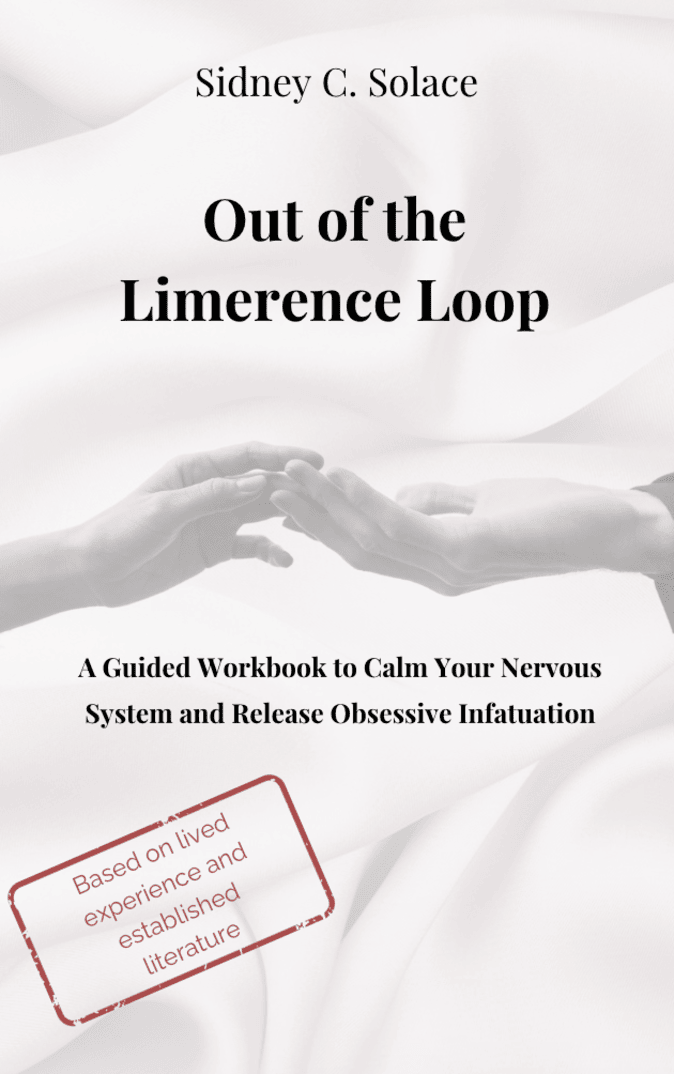
In my theory book, “Out of the Limerence Loop”, I explain what can happen when you become intensely focused on someone, why mixed signals and unattainable love can keep the cycle going, how earlier patterns of choosing and wanting to be chosen may play a role, and why change often starts with small, practical steps.
The accompanying workbook is specifically designed for practicing in the here and now: less fantasy, more body, more boundaries, and more freedom of choice in your day.
That applies just as much to limerence in friendships as in other relationships.
This doesn't mean we never talk about underlying patterns – they're allowed to exist – but the focus is on exercises: what can you do differently this week so that your life doesn't keep revolving around this one friend?
If you want to tackle this step by step, my workbook will help you go through these processes calmly and in a structured way.
Finally
If you’re experiencing limerence toward a friend, it doesn’t mean you’re a bad person or that the friendship itself is “wrong.”
It may be a sign that you’re longing for something—closeness, a sense of being chosen, or safety—and that the way things are now is causing you pain.
You can take that pain seriously and explore what combination of distance, practical exercises, conversation, and possibly therapy helps you regain space for yourself.
And you can be gentle about it: it's complicated, it often involves trial and error, and you don't have to figure it out alone.
Frequently Asked Questions about Limerence and Friendships
Is limerence for a friend “less bad” than for a partner or crush?
No. The experience can be just as intense, precisely because there is already closeness and history. It can strongly influence your life, relationships, and self-image. Ultimately, it's always more about you and the causes that make you susceptible to limerence than about the other person.
Do I always have to end the friendship when I feel limerence?
Not necessarily. Sometimes a temporary or structured distance is enough for the infatuation to subside. Sometimes it turns out that true friendship is only possible when limerence has truly lessened.
Should I tell my friend about my feelings?
That really depends on the situation. In some cases, honesty can bring relief, while in others it makes things heavier. It might help to talk to someone outside the friendship first (therapist, coach, confidant).
Is there something wrong with me for feeling this way about a friend?
No. Your feelings say something about your needs and patterns, not about your worth as a human being. You are not “broken”; you have a pattern that needs attention.
Can limerence in a friendship ever truly disappear?
Yes, for many people the intensity lessens when there's less fuel for the loop, more focus shifts to their own lives, and patterns are better understood. Sometimes a friendship continues afterwards, sometimes it doesn't; both outcomes are okay.
About the author

I’m Sidney, a writer and the person behind Sid’s Saferoom. I draw on years of personal experience with limerence, and I’m a certified trauma-informed coach (IPHM-accredited through The Complete Approach).
Knowing firsthand how lonely and exhausting obsessive infatuation can be, I dedicate my work to helping others heal. I write about it and developed the theory and workbook Out of the Limerence Loop. My mission is to provide you with the psychological insights and practical tools needed to interrupt the obsessive loop and restore peace to your nervous system.
- Want to know more? Read my full story on the About Me page.
- Weekly support? Subscribe to my English-language essays at substack.com.
Article photo; thank you to Chang Duong from Unsplash