

In this article, you’ll read why limerence so often shows up around unrequited love, forbidden love and unattainable people, and why that’s usually not “bad luck”, but a pattern in your nervous system. It’s often not that you just happen to fall in love with someone who is already taken, far away or emotionally unavailable. Most people sense that this person is out of reach fairly quickly, and that very sense of unavailability is what can trigger their system into a form of obsessive, lovesick infatuation. You’ll see how old pain, familiarity and a mix of hope and uncertainty can quietly pull you into a limerence state: intense longing, lots of fantasy, intrusive thoughts, and the feeling that you can’t really think straight about anything else.
In What is limerence?, I explain that limerence is more than just “really being in love”: it’s an obsessive form of love or infatuation that often grows stronger the less available someone is.
In my free English guide “Decode your Limerence”, I also provide insight into the needs that often lie behind limerence, so you can gain more control over what's going on in your head. You can download it here.
My experience: multiple limerence episodes, without knowing it had a name
Sometimes you feel ashamed because you keep developing crushes on people who really shouldn't have that kind of place in your life. Limerence and shame gives you language to describe that tension and explores what you can do about it.
The shame lessened when I began to understand why this was happening, and even more so when, halfway through a training program to become a trauma-informed coach, I noticed how many patterns were actually at play beneath this form of obsessive love.
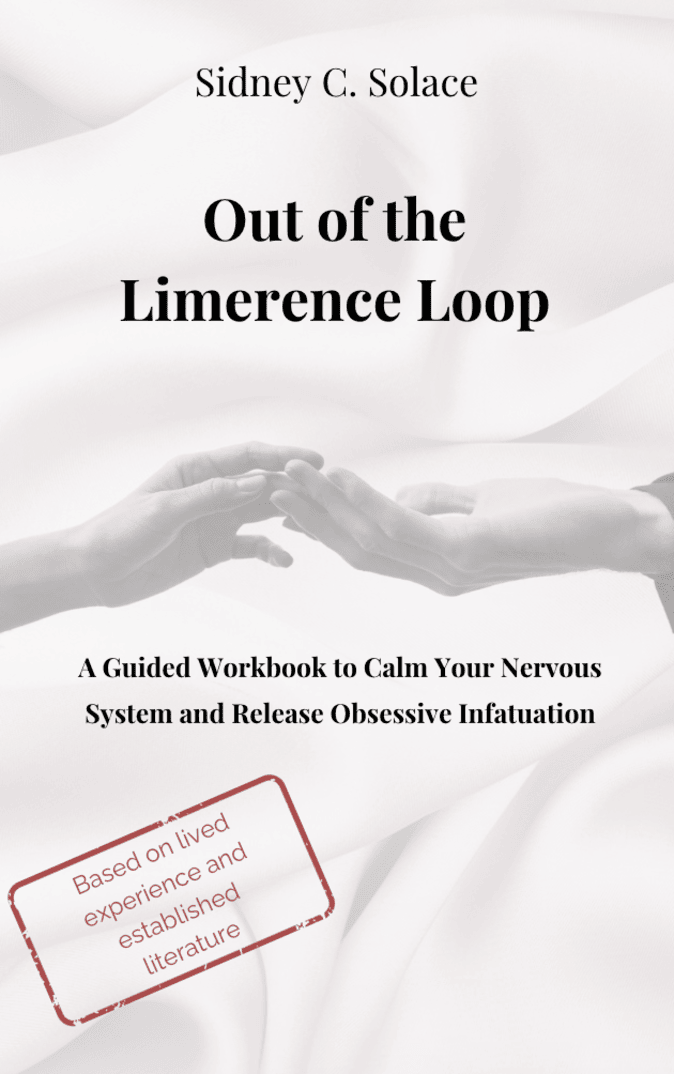
That experience is also why I wrote my theory and workbook “Out of the Limerence Loop”. Not to “fix” anyone, but to offer language and exercises to people who recognise themselves in this pattern: falling again and again for unattainable or unrequited love, repeatedly ending up in a lovesick‑like state of limerence, and not understanding why it feels so huge. In the workbook, you can gently explore which old pain is involved, which triggers your nervous system picks up, and how you can, step by step, create more space for real, mutual connection. This is the book I would have liked to have 15 years ago.
What is limerence, and how does it differ from unrequited love?
If you find yourself stuck in obsessive, unrequited love and don't know how to get out, also read How to stop limerence for more on recovery and relapse. And if your limerence plays out in a friendship, you'll recognize a lot in Limerence in friendship: obsessively in love with a friend.
Why unreachable and unrequited love fuels limerence
Someone is already in a relationship but is giving subtle signals. Someone is your colleague, therapist, teacher, or supervisor, making genuine reciprocity complicated. Someone is emotionally unavailable, but sometimes affectionate or charming Someone lives far away or you know them primarily online
In the blog Why him or her?, I explore why these particular people stir up so much within us. And in Limerence: what you often don't realize, you can read how seemingly subtle things can have a huge impact on your life.
The psychological layers beneath obsessive love
Anxious attachment can lead you to be attracted to someone who isn't fully available, because you recognize that feeling of “waiting for love.” Avoidant attachment can make unattainable love feel safer than someone who gets genuinely close; this way, everything stays in your head, without you having to truly open up. In more chaotic attachment patterns, the back-and-forth between hope and rejection can feel familiar, however painful.
What you often don't realize while you're in the midst of unrequited limerence
“If he/she finally truly sees who I am, everything will be okay.” “This is just very faithful, pure love, there's nothing wrong with that, is there?”
In Limerence is similar to addiction, I describe how this feels like repeatedly seeking a “rush”: a message, a glance, a brief moment of contact.
And in Limerence and your smartphone, you can see how constantly checking, scrolling, and waiting for a signal can further feed that lovesick state.
What's going on in your head?
If you find that this love is hurting your life, Limerence and Boundaries: When It Hurts Your Life is a blog that can help you find some words and first steps for that.
First small steps when you're stuck in obsessive, unrequited love
Identify that it concerns limerence. Just acknowledging that this is more than “bad luck in love” helps you emerge from the confusion. It gives you a name for it: this is obsessive, lovesick-like love, and that's something that happens more often. Recognize that the other person is unattainable or doesn't reciprocate your feelings. Not just in your head, but on paper: what facts show that reciprocal, healthy love isn't really possible here? It hurts to see that, but it makes you less dependent on hope alone. Limit the decoding of mini-signals. Try to build in moments where you consciously say: “I'm not going to overthink this today.” Check less, interpret neutral gestures less, and ask “what did he/she mean by this emoji?” less. Bring your attention back to your own life and body. Small exercises such as noticing what you see, hear, and feel, or consciously planning things that have nothing to do with this person, can help to loosen the circle in your head a little. Make room for grief and loneliness. Obsessive love often conceals a deeper layer of grief, an old loneliness, or the feeling of never truly having been chosen. You don't have to solve that all at once, but it's okay to acknowledge it.
For real structured processing, for example practising boundaries, exploring where this pattern comes from, and finding new ways to relate to desire, I created my workbook: a calm, practical place where you don’t just read about this, but truly work through it at your own pace.
Questions to reflect on
What makes this person so “unattainable” to me, and what draws me to that? Honestly, what earlier situation does this remind me of (e.g., in family, previous relationships, friendships)? What is this obsessive love doing to the rest of my life – my work, my body, my other relationships? How would real, reciprocal love differ from this situation?
Frequently Asked Questions about Limerence and Unrequited Love
Is unrequited love always limerence?
Why do I always fall for people who are unattainable?
Can obsessive love ever become healthy?
Should I always go no contact with unrequited limerence?
Am I a bad person for being in love with someone who is taken?
About the author

I’m Sidney, a writer and the person behind Sid’s Saferoom. I draw on years of personal experience with limerence, and I’m a certified trauma-informed coach (IPHM-accredited through The Complete Approach).
Knowing firsthand how lonely and exhausting obsessive infatuation can be, I dedicate my work to helping others heal. I write about it and developed the theory and workbook Out of the Limerence Loop. My mission is to provide you with the psychological insights and practical tools needed to interrupt the obsessive loop and restore peace to your nervous system.
- Want to know more? Read my full story on the About Me page.
Weekly support? Subscribe to my English-language essays at substack.com.