
In this article, you will read why recognizing limerence is often an important first step, but can also feel confronting. That is important when you are just beginning to see how much time your thoughts, fantasies, and inner conversations with your LO actually take up. You will find recognition, an explanation of why your brain keeps returning to that familiar route, and a first, small way to bring yourself back to the here and now.
Maybe you just discovered what limerence is. Or maybe you've known the word for a while, but it's only now starting to really sink in: This is about me. It can be a relief to finally find the words for something you couldn't explain. At the same time, that recognition can also be painful. Because as soon as you start to see what is happening, you sometimes only then realize how much space limerence has taken up in your head and your life.
That is not the moment when you fail. It is often precisely the moment when recovery cautiously begins.
When you see for the first time how much space limerence takes up
Before you know you are in limerence, a lot can feel almost normal. You often think about that person, but call it being in love. You fantasize about conversations, but think you are just hopeful. You reread a message, try to understand what someone meant, or replay an encounter in your head. Perhaps you don't even realize how much time disappears into that.
Only when you learn the word limerence can the penny drop. Then you see that you don't just like or miss someone. You may notice that your mood has become heavily dependent on potential signals, that your thoughts keep snapping back to the same person, and that a kind of parallel life has arisen in your head.
In What is Limerence Let me explain in more detail what limerence is and why it can go so much further than an intense crush. Recognizing this can bring a lot of relief. You are not alone and you are not “crazy.” But it can also confront you with something you previously did not want or were not able to fully see.
Maybe you suddenly think: How often am I actually in my head? How often am I not really present in my own day? How many conversations do I have with someone who isn't even here?
Those are difficult questions. You don't have to answer them to judge yourself. The very fact that you can ask them now means you are starting to see something that previously happened largely automatically. And if you first want to read more extensively about limerence and its characteristics, I can recommend this book by Dorothy Tenov.
10 Valuable Insights in a Free Guide
Some people who land on this page have googled limerence tens of times. You know the definition. You know the stages. But there's a big difference between knowing what it is and actually getting out of it. I wrote a free guide with 10 insights that go a bit deeper. A guide that can help you on your way and explain that you are not alone.
Why it might seem worse at first when you work on it
When you actively work on limerence, it can seem as if you are suddenly thinking about it even more often. For example, you start with an exercise, agree on an anchor phrase with yourself, or decide more consciously not to fantasize. Then, to your frustration, you notice how often you are already back with your LO.
But usually those thoughts haven't suddenly become much worse. You have just become more aware of them.
You can compare it to a sound that has always been present in the background. As long as you don't notice it, it doesn't seem that loud. But as soon as you pay attention to it, you suddenly hear how often it is there. That doesn't mean you caused the sound. It means your system is only now truly registering it.
With limerence, your brain can have grown accustomed for a long time to one familiar route: back to the LO. To fantasy, hope, analysis, memories, rewriting the past, or directing a possible future. That route can temporarily feel nice. Perhaps it provides comfort, excitement, distraction, or a small sense of hope. But it also keeps you away from the life that is actually in front of you now.
In The Limerence Cycle You’ll learn more about how hope, uncertainty, and small signs can feed into one another. When you start to recognize that cycle, you’ll often first notice just how often it still kicks in. That can feel discouraging, but it’s also valuable information.
My Parallel Life in My Head
When I began to realize that I was experiencing limerence, I didn't just feel relief. I also felt something unsettling. I realized how many years of my life I had actually spent living a kind of parallel life in my head.
My body could be somewhere else while my head was having conversations with my PE, trying to direct a future, replaying an old moment, or fantasizing about how things could have gone differently. Those fantasies could sometimes feel nice. They provided hope, comfort, excitement, or even a fleeting sense of connection. But meanwhile, they also pulled me further and further away from my own life.
For me, this happened most often at times when I didn’t need to use my full mental capacity. While walking, in the shower, and in the car, for example. It was precisely when I was physically active but my attention was free to wander that I would easily slip into a parallel reality.
But the annoying thing is that limerence can also be such a drain when you actually want to keep your attention on your partner, your children, or your work.
I often only noticed it when I was already far away. Then I had carried out a conversation in my head, relived something from the past, or completely thought out a future scenario. Those were not bad moments in themselves. Walking, showering, and driving can actually be pleasant moments of rest. But for my limerent brain, they had become vulnerable moments: there was silence, space, and little that truly held my attention.
After not being in touch for quite some time, I began to consciously bring myself back to the here and now. I kept using a powerful phrase that worked well for me: This is my life and this is what I have to work with.
That sentence gave me back a bit of control. But it also made painfully clear how often I had already descended into my head before I realized it.
That didn't mean the exercise wasn't working. On the contrary, it meant that I finally saw what was happening. At first, that awareness felt like more limerence, but it was actually the beginning of my recovery.
If you recognize yourself in this, you can Limerence: why you keep having conversations in your head help you better understand those inner conversations. You don't have to stop them completely right away in order to learn how to deal with them differently.
The moment you realize how much space limerence actually takes up can be painful, but it also opens up an important question: What do you need to be more present in your own life again?
Returning to the here and now is a skill
When recovering from limerence, we sometimes think we need one big insight. As if you just have to realize well enough that your LO is not good for you, and your brain will then stop by itself. But that is usually not how it works.
You can know very well that a situation hurt you, that you want to move on, or that contact doesn't help. And yet, in a quiet moment, your mind can drift back to the familiar fantasy. Not because you don't want to heal enough, but because this is a path your brain has used very often.
Therefore, it helps not to see recovery as a single decision, but as a skill that you practice over and over again. You notice that you have drifted. You name it without judgment. You choose a small anchor. And you come back.
That sounds simple, but simple is not the same as easy.
You could compare it to strength training. Working out your arms once at the gym won’t immediately change how strong you are. But if you practice the same movement for months, you’ll slowly build strength. It works the same way when you repeatedly bring your attention back from your imagination to the here and now.
You may have practiced for months or years on the path to your LO: analyzing, waiting, hoping, rereading, daydreaming, having inner conversations, and imagining possible futures. It is logical that this path does not disappear after a few days or weeks of practice. You are slowly building a second path: noticing, pausing, and returning to your own life.
The second route doesn't become stronger because you never stray again. It becomes stronger because you keep coming back over and over.
How you often see recovery slowly shift
Recovery rarely moves in a straight line. Nor is it the case that you decide to think differently on Monday and have no more limerence thoughts by Tuesday. Often, something much smaller shifts first.
At first, you might only realize afterward that you’ve been lost in fantasy or analysis for quite some time. Later, you’ll notice it while you’re in the midst of it. After that, you’ll sometimes recognize it just before you get completely swept up in it. And at certain moments, you’ll manage to pause for a moment and choose something else.
Only later do the waves often become shorter, the intervals longer, and the thoughts less determining for your day.
That process is neither neat nor predictable. On stressful days, when you are tired, feeling lonely, or have a lot of free headspace, it is easier to fall back into the old route. That does not undo previous progress.
In Limerence in no contact: two realities I write about that confusing phase in which you can simultaneously feel that you want to stay away and yet still have a strong urge to return to connection, fantasy, or hope. Both sides can exist at the same time. That doesn’t mean your recovery is fake.
To make a first start
If you’re just starting to realize how much space limerence takes up, you don’t have to break every pattern right away. It’s enough to recognize just one small moment each day when you’ve slipped back into an inner dialogue, fantasy, or analysis.
You can then try three simple things:
- Notice it without punishing yourself. For example, say: I'm in my head again. Not angry and not dramatic; just honest.
- Come back to one specific thing. Look around you, feel your feet on the ground, listen to a sound, or focus your attention on what you are doing at that moment.
- Postpone major decisions. When you are in a strong wave, you don't have to immediately decide whether to seek contact, look something up, or what a thought means. Return first; decide later.
That is not a complete solution. They are small initial moments when you notice: I may not have chosen this thought, but I can carefully choose what I do next.
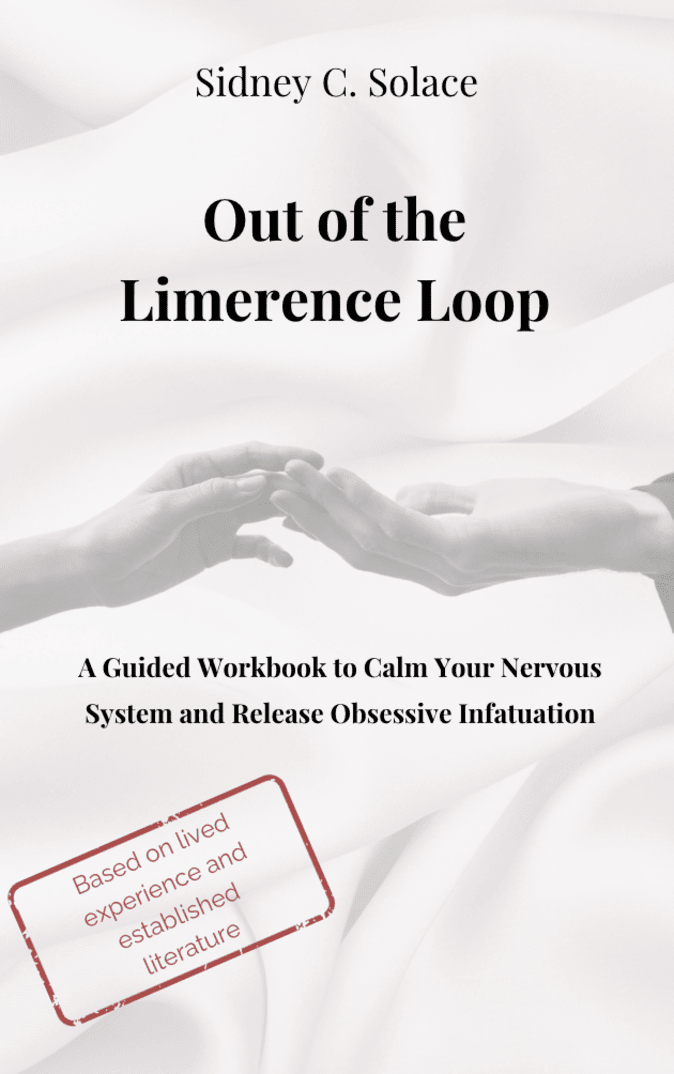
If you would like to work through this step by step, my theory, and workbook Out of the Limerence Loop can help you explore these patterns more calmly and systematically. Inside, you will find exercises to help you recognise fantasy and inner conversations, return to the present moment, and create a personal plan for the moments when you are most vulnerable.
You don't have to give up
When you are in this first phase, recovery can feel frustratingly slow. You might be thinking: I know what limerence is now, so why am I not over it yet? But insight is not an on-off switch. Insight is the beginning of a new kind of attention.
You don't have to prove you are strong by never fantasizing again, never missing anyone, or never hoping again. You are allowed to practice noticing sooner, returning more gently, and leaving yourself a little less alone during difficult moments.
You are not back to square one because you wander off again. Every time you notice it and come back, you are doing the work of recovery. It is slow work, but slow doesn't mean nothing is happening.
Frequently asked questions about limerence and recovery
Why do I think even more about my eating disorder now that I am working on recovery?
Often the thoughts haven't actually become more numerous; you just notice them better. As soon as you consciously practice recognizing limerence, you only then see how many automatic fantasies, analyses, and inner conversations were already there.
Does fantasizing about my LO mean I am not recovering?
No. Recovery does not mean that you will never have a thought or fantasy again. It is increasingly about following the thought for less time, feeding it less often, and being able to return to yourself more quickly.
Why do I often lose my focus while walking, showering, or driving?
Those are moments when your body is busy, but your mind has a relatively large amount of free space. If your brain has gotten used to fantasizing or analyzing about your PE, it can automatically choose that familiar route precisely during those quiet moments.
How long does recovery from limerence take?
There is no fixed time for it. Recovery depends, among other things, on the intensity of the limerence, contact or triggers, your stress level, and the patterns underlying the feelings. Look especially at the small shifts that show your development.
What if I can't manage on my own?
Then you don't have to do it alone. A therapist, coach, or safe support person can help, especially if limerence strongly affects your daily life, relationships, sleep, work, or self-image. If you find that a step too far, my workbook can also provide structure to actually keep repeating small exercises.
About the author

I am Sidney, writer, researcher, and the driving force behind Sid's Saferoom. In addition to my years of personal experience with breaking free from limerence, I am certified Trauma-Informed Coach (IPHM-accredited via Kirsty Watson, The Complete Approach).
Knowing firsthand how lonely and exhausting obsessive infatuation can be, I dedicate my work to helping others heal. I write about it and developed the theory and workbook Out of the Limerence Loop. My mission is to provide you with the psychological insights and practical tools needed to interrupt the obsessive loop and restore peace to your nervous system.
- Want to know more? Read my full story on the About me-page.
- Weekly support? Subscribe to my English-language essays at substack.com.