
Life and love after limerence: will I ever feel normal again?

Woman with hand in hair, face invisible. Despair of Limerence

In this article, you'll read about what love can look like after limerence, what realistic recovery entails, and which small steps will help you avoid getting stuck in obsessive patterns forever.

When you're in the midst of limerence, it often feels like your love life is “broken” forever. As if you'll either always love obsessively or never truly feel anything again. Many people wonder: Will there ever be a relationship that isn't so intense, but is real?

The short answer: yes, it's possible – but it will likely look different than you're used to now. Did you end up here without knowing exactly what limerence is? In this article I'll explain What limerence specifically is and how to recognize it in your daily life.

And if, after a breakup or taking time apart, you notice your thoughts still keep circling, then also read Limerence and closure: when your mind won’t let go after the contact ends.


What we often expect from love after limerence

With limerence, you usually long for two things at once: security and fire. You never want to be shattered by obsession again, but you're also afraid of “boring” relationships. Your system often still equates intensity with love: a lot of tension, a lot of drama, a lot of worrying.

Healthy love sometimes feels almost too calm at first in comparison. Less worrying, less high, less panic when you don't hear from them for a while – and precisely because of that, it can seem awkward, flat, or even “boring.” That's not a sign that you don't feel anything, but that your nervous system is still used to adrenaline instead of regulation.

If you're in the middle of recovery and still notice that your thoughts keep returning to someone outside your relationship, my article In Love with Someone Other Than Your Partner can help you better understand and make sense of the tension between your existing relationship and your limerence.

Even when the relationship is truly over, your mind can keep replaying imaginary conversations for a long time. In Why You Keep Having Conversations in Your Head with Your Ex, you can read about how this works and how you can still begin to make room for a life after limerence.


Recovery is not a “fix” but a shift.

There is no magic exercise that will make you never experience limerence again. Recovery is more like a shift:

  • From looking for everything outside yourself to becoming more able to stay connected to yourself
  • From fantasy and idealization, to being curious about the real other
  • From chasing stimuli to realizing that rest is also valuable

Recovery isn't a straight line. You can feel very stable for a while and then suddenly be triggered again by someone new or a former LO. The difference is that you recognize what's happening sooner and have more tools to support yourself. If you want to understand how you ended up experiencing limerence in the first place and why it lasted so long, How Does Limerence Develop and How Long Does It Last? offers more background and some first steps.

10 Valuable Insights in a Free Guide

You may have searched for information about limerence many times already. You know the definition, and you recognise the patterns. But understanding limerence and finding your way out of the loop can feel like two very different things. I wrote a free guide with 10 insights that go a little deeper, to help you make sense of your experience, take a first step, and feel less alone.

Download the free guide here.


Three movements that almost everyone encounters in recovery

These are not “1-2-3 and done” step-by-step plans, but movements that recur in many recovery stories.

  1. From LO-focus to self-focus
    You learn to not constantly redirect your attention to “what is he/she thinking or feeling?”, but to gently bring it back to “what is happening within me right now?”. That sounds simple, but it's intense work – especially if your brain has used "other-oriented thinking" as a survival strategy for years.
  2. From all-or-nothing to nuance
    In limerence, things are often black and white: perfect or disaster, soulmate or no one, all or nothing. In recovery, more room emerges for “okay,” “good enough,” “not yet sure.” This makes relationships less dramatic, but also more real.
  3. From control to contact
    Instead of trying to control the other person (or yourself) – texts, timing, distance, closeness – shift towards genuine connection: being able to say what's happening within you, setting boundaries, asking for something instead of guessing. That feels vulnerable, but it's also where healthy intimacy begins.

Do you find yourself dwelling on the question of why it has to be this particular person, despite everything? In this article, I will delve deeper into why exactly he or she can be such a strong trigger for your limerence.

If you feel that limerence continues to be a recurring pattern in your life, “How to stop limerence ” can help you see, in concrete terms, that stopping is a gradual process, in which various exercises and changes can all work together to help.

Many people only begin to move forward when they feel able to seek help. In Limerence Treatment: What Help Is Right for You?, I describe different options and how you can explore what suits you.


How do you know you're healing?

There is no yardstick, but there are signs that many people recognize as signs of recovery:

  • You can have longer moments when you are not thinking about your LO.
  • You notice triggers (“oh, I'm going into idealization again”) instead of automatically going along with them.
  • You can comfort or regulate yourself without immediately seeking contact or stalking.
  • Your interest is slowly shifting from “how do I get him/her?” to “how do I want to feel in relationships?”

And perhaps most importantly: you start to believe that your love story isn't tied to that one person. That there are multiple paths to connection, and that you have an active role in it.

Do you feel you still need help, and is limerence continuing to cause distress in your daily life? I wrote a book, Out of the Limerence Loop, in which I explain the theory behind limerence and share practical exercises that helped me gradually break free from this pattern in my daily life. I experienced episodes of limerence from my teenage years well into my forties, and this book grew out of that experience.
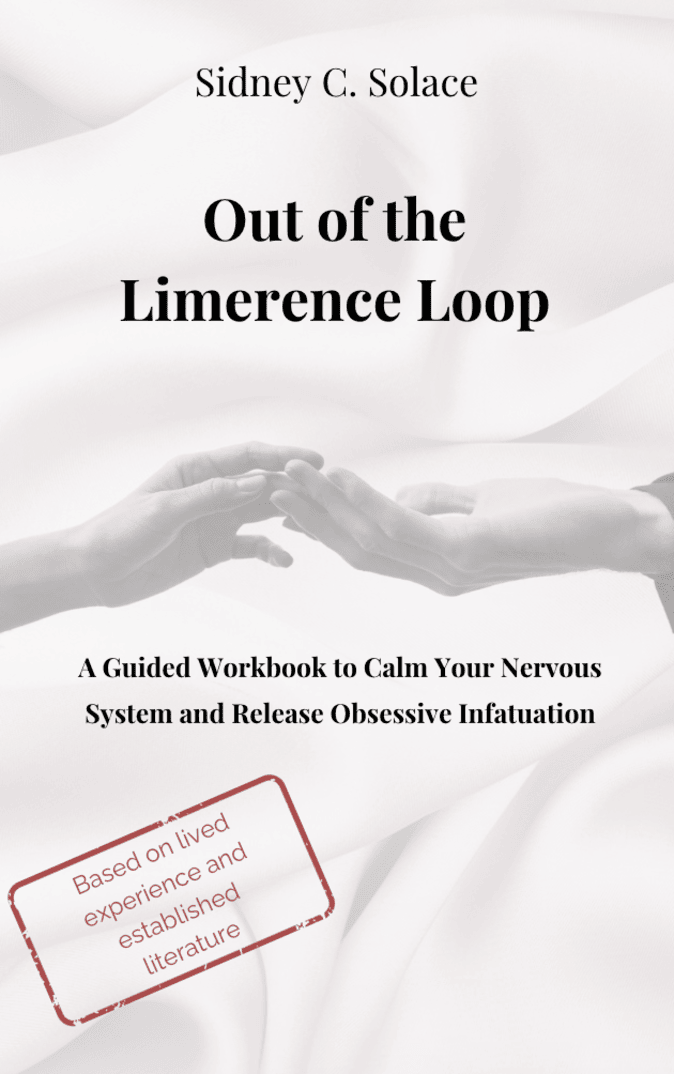
The book cover. Breaking Free from Limerence by Sidney C. Solace

What if you're afraid you'll never feel good again?

The fear is very normal. Limerence often feels like the most intense thing you've ever experienced. The thought that you'll never feel that way again can bring on grief – for the LO, but also for a version of yourself that could become so engrossed in someone.

It helps to put two things side by side:

  • Yes, the emotional highs were really intense.
  • And yes, the price you paid for it – in fear, control, dependence – was also real.

Recovery doesn't mean you'll never get hurt or love deeply again. It means you're no longer willing to lose yourself completely to feel that intensity. Are you still in the phase where keeping your distance or having less contact feels almost impossible? In this article, you can read more about No contact with limerence and why distance is so difficult.

When you're ready to explore which boundaries can help you move step by step towards a life without limerence, Limerence and Boundaries: Why Recovery Goes Against Your Tendencies can be a next step.


Love after limerence: what can that look like?

Healthy love after limerence is often less cinematic, but much more reliable:

  • Someone who is consistent, even when you're wavering.
  • There is space for your inner world, without the other person needing to “save” you.
  • Conflicts that don't immediately feel like the end of the world.
  • Attraction that isn't based on drama, mystery, or unattainability.

It might take a while for your system to recognize that as attractive. Sometimes this only happens after you've spent time in therapy, exploring yourself, or being on your own.

If you want to recognize things you may not have noticed while you were in the midst of limerence — such as how much you gave, how often you got lost in thought or absorbed in your phone, and how that affected the people around you — Limerence: What You Often Don't Realize While You're in It offers an honest reflection that may feel familiar.

Frequently Asked Questions about Love and Life After Limerence

Does limerence ever fully go away? Can limerence stop?

For many people, limerence becomes less intense and less all-consuming over time, especially when you work on your patterns and triggers. It's not so much “gone,” but it has less power over your choices and self-image. You can truly overcome it.

Can I have a healthy relationship after limerence?

Yes. Many people find that after this phase, they start to make more conscious choices, feel their boundaries better, and dare to be more honest about their needs. Healthy love often feels calmer and safer than you are used to with limerence, but no less real.

How do I know if I'm recovering from limerence?

Signs include less obsessive thinking about the person you're experiencing limerence toward, better sleep, less urge to force contact, and more interest in your own life. You'll also often notice: “I feel bad, but I can handle this,” without immediately needing the other person as an escape route.

What if I'm afraid I'll never feel good again?

Unfortunately, anxiety fits very well with limerence because your mood becomes so tied to one person and one story. Precisely by building your own regulation, sources of support, and meaning outside of that relationship step by step, trust slowly re-emerges that you are more than this phase.

About the author

Sidney's eyes

I’m Sidney, a writer and the person behind Sid’s Saferoom. I draw on years of personal experience with limerence, and I’m a certified trauma-informed coach (IPHM-accredited through The Complete Approach).

Knowing firsthand how lonely and exhausting obsessive infatuation can be, I dedicate my work to helping others heal. I write about it and developed the theory and workbook Out of the Limerence Loop. My mission is to provide you with the psychological insights and practical tools needed to interrupt the obsessive loop and restore peace to your nervous system.

  • Want to know more? Read my full story on the About Me page.
  • Weekly support? Subscribe to my English-language essays at substack.com.


Scroll to Top
sidssaferoom.com
Home
Recovery and help
Life and love after limerence: will I ever feel normal again?
Worried you'll never feel good again? Love and life after limerence
Does limerence ever completely go away? Can limerence stop?
For many people, limerence becomes less intense and less all-consuming over time, especially when you work on your patterns and triggers. It's not so much “gone,” but it has less power over your choices and self-image. You can truly overcome it.
Can I have a healthy relationship after limerence?
Yes. Many people find that after this phase, they start to make more conscious choices, feel their boundaries better, and dare to be more honest about their needs. Healthy love often feels calmer and safer than you are used to with limerence, but no less real.
How do I know if I'm recovering from limerence?
Signs include less obsessive thinking about the person you're experiencing limerence toward, better sleep, less urge to force contact, and more interest in your own life. You'll also often notice: “I feel bad, but I can handle this,” without immediately needing the other person as an escape route.
What if I'm afraid I'll never feel good again?
Unfortunately, anxiety fits very well with limerence because your mood becomes so tied to one person and one story. Precisely by building your own regulation, sources of support, and meaning outside of that relationship step by step, trust slowly re-emerges that you are more than this phase.
Sidney
Afraid you’ll never feel truly okay again after limerence? Learn what recovery really looks like and why mutual love is still possible later on.
Here's some information that may help with obsessive thoughts:**What are obsessive thoughts?**Obsessive thoughts, also known as obsessions, are unwanted, intrusive, and persistent thoughts, images, or urges that cause significant distress or anxiety. They can be about a wide range of topics, such as:* **Contamination or germs:** Fear of getting sick or spreading illness. * **Harm:** Fear of harming yourself or others, even if you have no intention of doing so. * **Unwanted sexual thoughts:** Intrusive sexual images or thoughts that are disturbing or taboo. * **Religious or moral scrupulosity:** Excessive worry about acting against one's religious or moral beliefs. * **Order and symmetry:** A need for things to be just right, perfectly arranged, or in a specific order. * **Doubt:** Persistent uncertainty about whether you did something or made the right decision.These thoughts are often illogical or irrational to the person experiencing them, but they still feel very real and distressing.**What is the difference between obsessive thoughts and worries?**While both involve preoccupation with an issue, obsessive thoughts are typically:* **Intrusive and unwanted:** They pop into your head without being invited. * **Distressing and anxiety-provoking:** They cause significant emotional discomfort. * **Ego-dystonic:** They are inconsistent with the person's values and beliefs. * **Difficult to dismiss:** Even when you try to push them away, they tend to return.Worries, on the other hand, are often related to real-life problems and are more manageable or can be resolved with problem-solving.**What causes obsessive thoughts?**The exact causes are not fully understood, but it's believed to be a combination of factors including:* **Genetics:** A family history of obsessive-compulsive disorder (OCD) or related conditions. * **Brain chemistry:** Imbalances in certain neurotransmitters in the brain. * **Brain structure and function:** Differences in certain areas of the brain. * **Life experiences:** Stressful events or trauma can sometimes trigger or worsen obsessions.**When should you seek professional help?**Obsessive thoughts can be a symptom of Obsessive-Compulsive Disorder (OCD) or other anxiety disorders. It's important to seek professional help if your obsessive thoughts:* Cause you significant distress or anxiety. * Interfere with your daily life, relationships, work, or school. * Lead you to engage in compulsive behaviors to reduce the anxiety (compulsions are repetitive behaviors or mental acts that a person feels driven to perform in response to an obsession). * Are causing you to feel overwhelmed or hopeless.**What are the treatment options?**The most effective treatments for obsessive thoughts, especially when they are part of OCD, include:1. **Cognitive Behavioral Therapy (CBT):** * **Exposure and Response Prevention (ERP):** This is considered the gold standard for OCD. It involves gradually exposing yourself to the thoughts, images, or situations that trigger your obsessions, while refraining from performing your usual compulsions. The goal is to learn that you can tolerate the anxiety without engaging in compulsions, and that the anxiety will eventually decrease on its own. * **Cognitive Restructuring:** This involves identifying and challenging the distorted thinking patterns associated with your obsessions.2. **Medication:** * **Selective Serotonin Reuptake Inhibitors (SSRIs):** These antidepressants are often prescribed to help manage anxiety and reduce the intensity of obsessions and compulsions. * **Other medications:** In some cases, other types of medication may be used.**What can you do for yourself?**While professional help is crucial, there are some self-help strategies that can be complementary:* **Educate yourself:** Understanding OCD and obsessive thoughts can be empowering. * **Practice mindfulness:** Mindfulness techniques can help you observe your thoughts without judgment and detach from them. This doesn't mean getting rid of the thoughts, but rather changing your relationship with them. * **Develop coping strategies:** When an obsessive thought arises, try to remind yourself that it's just a thought and not a reflection of reality or your intentions. * **Reduce stress:** Engage in stress-reducing activities like exercise, yoga, meditation, or spending time in nature. * **Build a support system:** Talk to trusted friends, family members, or join a support group. * **Maintain a healthy lifestyle:** Ensure you're getting enough sleep, eating a balanced diet, and avoiding excessive caffeine and alcohol. * **Challenge your "what if" thinking:** Obsessive thoughts often involve catastrophic "what if" scenarios. Learn to recognize and question these assumptions.**Important Reminder:**If you are experiencing severe distress, having thoughts of harming yourself or others, or if your obsessive thoughts are significantly impacting your life, please reach out for professional help immediately.* **National Suicide Prevention Lifeline:** 988 * **Crisis Text Line:** Text HOME to 741741
Life and love after limerence: will I ever feel normal again?
Sidney
BreadcrumbList
Home
Recovery and help
In this article, you will read about what love can look like after limerence, what realistic recovery entails, and which small steps will help you avoid staying stuck forever.